

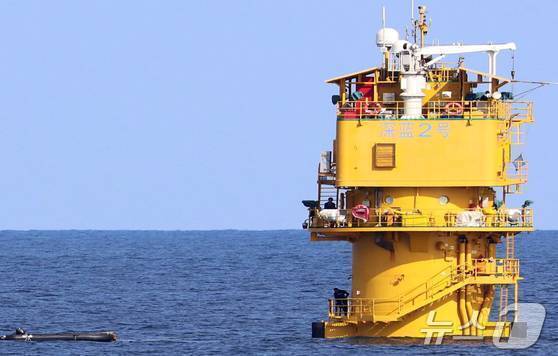
The Center for Strategic and International Studies (CSIS), a prominent U.S. think tank, has confirmed that China removed the management facility from two aquaculture farms it unilaterally established in the Korea-China Provisional Measures Zone (PMZ) in the Yellow Sea. However, the think tank noted that the two farms continue to operate, raising questions about China’s intentions.
Satellite imagery analysis conducted by CSIS on Monday revealed that the aquaculture farms Shenlan 1 and Shenlan 2, unilaterally installed by China in the PMZ, remain operational in the area.
China set up Shenlan 1 and Shenlan 2 in the PMZ in 2018 and 2024, respectively. In 2022, it added a management platform for these farms, repurposing the Atlantic Amsterdam, a former oil drilling rig, to accommodate a small crew.
South Korea and China established the PMZ in overlapping Exclusive Economic Zones (EEZ) in the Yellow Sea, agreeing under the Korea-China Fisheries Agreement to limit activities in the area to fishing only.
While Beijing maintains that these facilities are privately-owned deep-sea salmon farming operations within normal fishing activities, concerns persist that they could be part of China’s gray zone tactics. Critics worry these installations might evolve into maritime surveillance and control points or be repurposed for military use.
During a state visit to Beijing on January 5, President Lee Jae Myung raised this issue in talks with Chinese President Xi Jinping. As a result, China agreed to withdraw the management facility from the PMZ.
The management facility began relocating on January 27 and was confirmed to have arrived at a commercial shipyard in Weihai, Shandong Province, China, about 250 kilometers (about 155 miles) from its original position, on January 31.
South Korea’s Ministry of Foreign Affairs has officially verified China’s removal of the management facility from the PMZ.
A ministry spokesperson stated that it has confirmed the complete relocation of the facility outside the provisional measures zone. The government will continue to pursue progress on this matter through constructive dialogue with China, maintaining the consistent position.
Despite this development, CSIS expressed ongoing skepticism about whether Shenlan 1 and Shenlan 2 will continue to function solely as aquaculture farms.
Diplomatic channels between South Korea and China are currently working to arrange a meeting of their foreign ministers. If convened, the relocation of the remaining aquaculture facilities is expected to be on the agenda.
Before departing for the U.S., Foreign Minister Park Jin told reporters at Incheon International Airport that it is aiming to hold the Korea-China foreign ministers’ meeting as soon as possible. When asked if the removal of the two remaining aquaculture farms would be discussed, he confirmed that it is included in the agenda.