

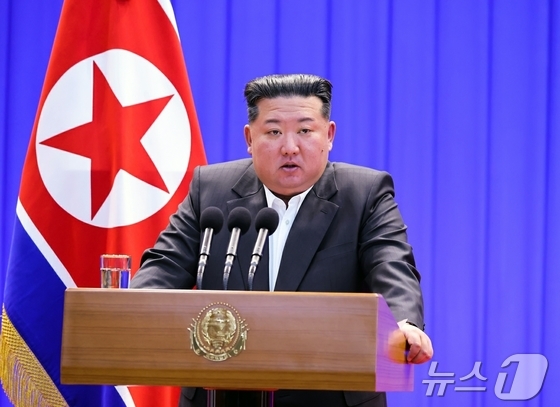
Experts anticipate that North Korea may introduce Kim Jong Un’s revolutionary ideology as the party’s supreme doctrine at the upcoming 9th Workers’ Party Congress.
On February 8, the Unification Research Institute, a government-funded think tank, presented this forecast in its comprehensive study titled, North Korea’s Party Congress and Political Transformations.
The institute suggests that while the core structure of the Party Charter established during the 8th Party Congress in 2021 is unlikely to undergo major changes, Kim’s revolutionary ideology, previously absent from the party charter’s preamble, might be formally recognized as the Workers’ Party’s highest guiding principle.
This Congress could serve as a platform to consolidate various governance philosophies, introduced through Supreme Leader Kim’s speeches and state media since his ascension to power, into a distinct revolutionary ideology. This would be akin to President Kim Il Sung’s Juche Idea and Chairman Kim Jong Il’s Songun Policy.
Specifically, concepts such as △Our State First (political) △People First (social) △Self-Reliance First (military) might be outlined as subcategories of the party’s supreme doctrine.
The institute particularly noted that following North Korea’s declaration to elevate ideological uniformity across society to new heights during the 2nd Propaganda Sector Training Session held from April 20 to 23, 2024, the Rodong Sinmun has been publishing special reports emphasizing the ideology of the Kim era.
Despite North Korea’s extensive propaganda efforts, the institute points out that the precise content and framework of Kim’s revolutionary ideology remain undefined. They observed an increase in references to Kim’s ideology in state media like the Rodong Sinmun as the party congress approaches.
Potential modifications to sections concerning inter-Korean relations in the Workers’ Party charter are also being widely discussed.
The institute notes that North Korea, which previously emphasized a nation-centric unification approach, began to downplay this focus at the 8th Party Congress, instead highlighting policies centered on the concept of state.
The institute observed that in the five years following the 8th Party Congress, North Korea has consistently implemented internal measures supporting a hostile two-state policy. Given North Korea’s ongoing distrust and refusal to engage in dialogue with South Korea, coupled with its criticism of U.S.-South Korea joint military exercises, the institute speculates that the principles of independence, peaceful unification, and national unity might be discarded at this upcoming party congress.