

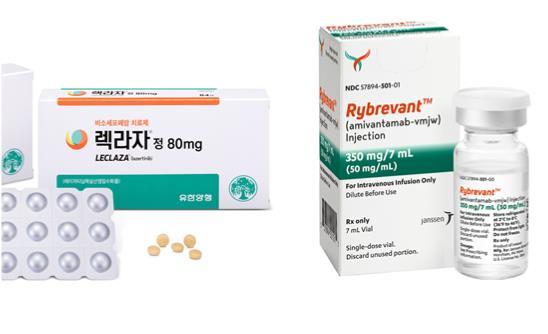
On Tuesday, the National Comprehensive Cancer Network (NCCN) released updated guidelines elevating the combination therapy of Leclaza (lazertinib), developed by Oscotec and Yuhan Corporation, and Johnson & Johnson’s Rybrevant (amivantamab) to standard treatment status for lung cancer. This development is expected to expand access for more patients.
Leclaza + Rybrevant Approved for First-Line Lung Cancer Treatment
The revised NCCN guidelines now classify the Leclaza + Rybrevant combination as a Category 1 and preferred first-line treatment option for patients with locally advanced or metastatic non-small cell lung cancer positive for EGFR exon 19 deletions or exon 21 L858R mutations.
This upgrade signifies that the combination therapy has achieved a clinical recommendation level on par with existing standard treatments. The elevation is primarily based on overall survival (OS) data from the Phase 3 MARIPOSA trial.
NCCN guidelines are a globally respected resource for oncologists making treatment decisions. With this update, the Leclaza + Rybrevant combination now shares the highest recommendation level alongside established monotherapies and combination treatments.
The NCCN emphasizes superior efficacy, safety, and evidence level when designating preferred therapies.
Beyond the status upgrade, the guidelines now include detailed side effect management protocols, aimed at facilitating real-world clinical use.
New recommendations include anticoagulant administration to prevent venous thromboembolism (VTE) when initiating Leclaza + Rybrevant as first-line treatment. The guidelines also advise oral dexamethasone two days before the first infusion to mitigate infusion-related reactions (IRR).
Specific preventive measures for skin-related adverse events are outlined. These include prophylactic oral antibiotics, topical clindamycin lotion for the scalp, chlorhexidine for nails, and ceramide-based moisturizers.
These comprehensive management guidelines are expected to help clinicians proactively address side effects and improve patient adherence.

Leclaza Monotherapy Reevaluated for Second-Line Treatment
The guidelines also address second-line treatment scenarios following first-line therapy failure.
If disease progression occurs after standard therapies or Leclaza + Rybrevant combination, continued use may be considered as a Category 2A or other recommended option in specific patient situations.
Leclaza monotherapy has also been added to the guidelines based on exploratory analyses from Phase 3 trials, reaffirming its clinical value both as part of the combination and as a standalone treatment.
This revision establishes the Leclaza + Rybrevant combination as a standard first-line treatment option, rather than an alternative therapy.
The survival benefits demonstrated in Phase 3 studies, which form the basis for the highest recommendation level, are expected to positively impact global market share expansion.
An industry insider commented that achieving preferred therapy status in the NCCN guidelines positions this combination as a top consideration for healthcare providers globally, including in the U.S. The inclusion of detailed side effect management protocols will likely reduce barriers to adoption in clinical practice, intensifying competition with existing treatments.