

As the United States signals potential tariff hikes on South Korean products, intensifying pressure across multiple fronts, trade officials from both nations convened in Seoul to address pressing issues, including the elimination of non-tariff barriers.
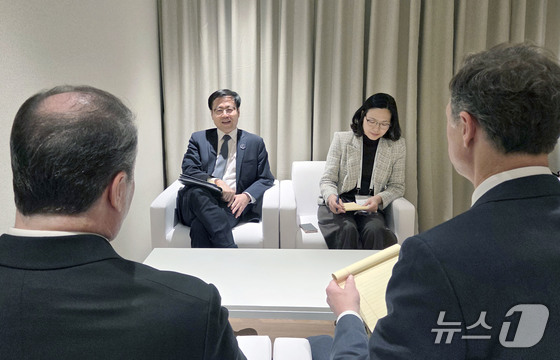
The Ministry of Trade, Industry and Energy reported that Yeo Han Koo, South Korea’s chief trade negotiator, met with visiting U.S. Deputy Trade Representative Rick Switzer on the morning of Wednesday. Their discussions, lasting approximately 90 minutes from 9:30 AM, focused on the implementation status and future plans for the non-tariff agreements outlined in the Joint Fact Sheet (JFS) agreed to by the leaders of both countries last year.
In November, the two nations agreed via the fact sheet to remove the cap on recognizing U.S. automotive safety standards as equivalent and to ensure non-discriminatory treatment for U.S. companies in the digital sector. They also planned to develop an implementation strategy through the Korea-U.S. Free Trade Agreement (FTA) Joint Committee.
Recognition of U.S. automotive safety standards’ equivalence allows U.S. vehicles that meet federal safety standards to be imported into South Korea without additional modifications. Currently, this is limited to an annual quota of 50,000 vehicles.
Last year’s fact sheet included commitments to protect U.S. companies from discrimination or unnecessary barriers in digital service laws and policies, including network usage fees and online platform regulations. It also pledged to facilitate cross-border data transfers, including location data, reinsurance information, and personal data.
Reports suggest that the U.S. continues to pressure the South Korean government over non-tariff barriers in the digital sector.
On January 13, U.S. Chargé d’Affaires James Heller sent a letter to Deputy Prime Minister and Minister of Science and ICT Lee Baek Gun, urging the implementation of digital-related agreements from the Korea-U.S. Joint Fact Sheet.
The U.S. National Trade Estimate Report for 2025, released last March, highlighted several non-tariff barriers in the digital sector, including: proposed network usage fees for foreign content companies, regulation of large digital platforms, restrictions on exporting location-based data, personal data localization requirements, and limitations on foreign cloud services for critical national security technologies.
During the meeting, Yeo reaffirmed the South Korean government’s commitment to implementing existing agreements with the U.S. and focused on progress in non-tariff areas, particularly in the digital realm. He also proposed ongoing discussions to finalize details for convening the Korea-U.S. FTA Joint Committee in the near future.
The Joint Committee was initially scheduled for December last year, but has been delayed due to diverging positions. According to Politico, a U.S. political news outlet, the committee meeting was canceled after the committee failed to bridge the gap on U.S. concerns about non-tariff barriers in the digital sector.
Since the beginning of this year, Yeo has held five meetings with U.S. Trade Representative Jamieson Greer to discuss non-tariff issues and strategies for stabilizing Korea-U.S. trade relations.
Yeo said that to ensure the stable management of Korea-U.S. trade issues, the government will keep an ongoing communication channel with the USTR.