

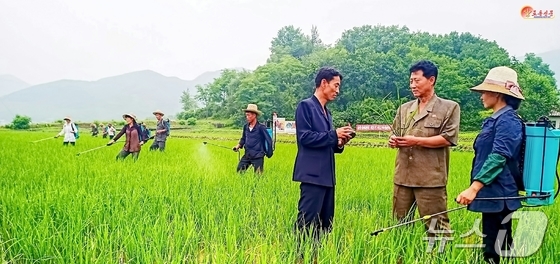
North Korea’s rice cultivation area expanded by 3.1% last year, primarily due to land reclamation efforts.
South Korea’s Ministry of Data and Statistics released its 2025 North Korea Rice Cultivation Area Survey on Thursday, revealing that the country’s rice fields now cover 542,913 hectares, an increase of 16,243 hectares (3.1%) from the previous year’s 526,670 hectares.
This marks the first growth in North Korea’s rice cultivation area since 2021, ending a four-year decline.
Experts attribute this expansion to the recovery from major flood damage in 2024 and ongoing land reclamation projects.
A spokesperson for the Ministry of Data and Statistics stated that it appears that large-scale land reclamation efforts have enabled cultivation in new areas. Additionally, the recovery from significant flood damage along the Yalu River basin in July 2024 has contributed to this increase.
By region, South Hwanghae Province led with 141,827 hectares (26.1%), followed by North Pyongan Province at 104,557 hectares (19.3%), and South Pyongan Province with 80,021 hectares (14.7%).
The survey relied on visual analysis of satellite imagery captured over North Korean territory between April and September of last year.
The Ministry of Data and Statistics has been conducting these surveys since 2020 to inform agricultural policies and research related to food security issues in North Korea.