

The U.S. has signaled a potential large-scale follow-up attack on Iran, while Iran has elected Mojtaba Khamenei, the son of the late Ayatollah Ali Khamenei, as its new hardline leader. This development is further exacerbating tensions in the Middle East.
Interestingly, North Korea, which has historically shared an anti-American stance with Iran, has maintained a strategic silence since issuing an initial condemnation of the U.S. airstrikes through its Foreign Ministry. Analysts suggest this restraint is aimed at avoiding unnecessary provocations towards the U.S.
Some observers speculate that if President Donald Trump pushes for renewed talks with North Korea as a political maneuver to address the Middle East crisis, Pyongyang, feeling pressured by ongoing U.S. military operations, might be more inclined to engage with Trump’s proposals.
On Monday, Iran’s Assembly of Experts officially elected Mojtaba Khamenei as the third Supreme Leader of the Islamic Republic. Mojtaba Khamenei is known for his extreme anti-American views and close ties to the Islamic Revolutionary Guard Corps (IRGC). The Trump administration had previously opposed Mojtaba Khamenei ‘s succession to power.
Iran’s choice of Mojtaba Khamenei as its next leader is seen as a move to maintain a strong stance of resistance amid escalating military tensions with the U.S. and Israel. Experts predict that the new Iranian leadership will further empower the IRGC, potentially intensifying and prolonging conflicts in the Middle East.
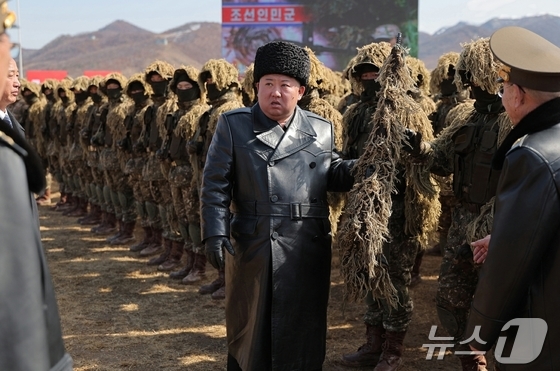
However, North Korea has remained surprisingly quiet since the initial U.S. airstrikes on Iran on February 28. After issuing a condemnation through its Foreign Ministry on March 2, Pyongyang has offered no further reactions. Notably, they have not even acknowledged Khamenei’s death.
Analysts suggest that Kim Jong Un may be avoiding provoking the U.S. by refraining from commenting on Khamenei’s death. Alternatively, he might be considering the possibility of engagement with the U.S. ahead of President Trump’s visit to China at the end of March.
While North Korea has long maintained that denuclearization is off the table, the Trump administration’s aggressive actions against a nuclear-capable Iran may be prompting Pyongyang to reassess its strategy.
However, experts believe it’s unlikely that the U.S. would apply the same level of military pressure on North Korea as it has on Iran, given North Korea’s nuclear capabilities.
Unlike Iran, North Korea already possesses deployed nuclear weapons and is generally considered to have superior air defense capabilities. Moreover, with China and Russia’s backing, any U.S. preemptive strike on North Korea could risk escalating tensions across Northeast Asia.
In this context, if President Trump extends an olive branch to a more cautious North Korea, there’s a possibility that Kim, who has previously rejected U.S. overtures, might reconsider his stance.
President Trump is scheduled to visit Beijing from March 31 to April 2 for a summit with President Xi Jinping. The administration is working to facilitate U.S.-North Korea contact during this period.
China, while critical of the war in the Middle East, has refrained from directly blaming the United States, indicating a desire to proceed with the upcoming U.S.-China summit. North Korea is likely monitoring these developments closely.
Park Won-gon, a professor of North Korean Studies at Ewha Womans University, stated that Kim faces increasing uncertainties regarding the U.S., which may lead him to engage in dialogue as a way to manage risks related to President Trump. However, the importance of nuclear weapons for Kim’s regime survival has likely increased, so he will not agree to negotiations that involve giving up or dismantling his nuclear arsenal.