

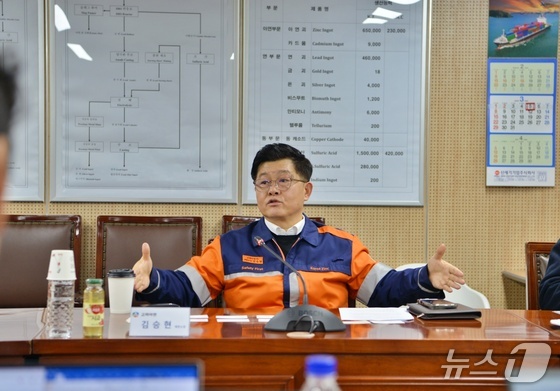
Kim Seung-hyun, Vice President of Korea Zinc’s Onsan smelter, envisions that the construction of an integrated smelter in the U.S. will not only benefit America but also enable the Onsan facility to advance its processes by incorporating cutting-edge technologies like artificial intelligence (AI) and robotics. This forward-thinking approach allows for the implementation of technologies that were previously challenging to apply.
At a press briefing held at the Onsan smelter on March 5, Kim explained that while they’re making strides in developing AI, robotics, automation, and digitalization technologies, there are inherent limitations to testing them during ongoing operations. The new plant will provide them with an ideal testing ground for immediate experimentation.
He further elaborated that successful trials at the new plant can be replicated at Onsan, creating a synergistic effect. This will allow the engineers to practically apply concepts they’ve only studied theoretically, such as AI implementation, automated operations, and the commissioning of new equipment.
Kim highlighted that Chairman Choi Yoon-beom places the highest priority on AI and robotics development. They’ve already deployed Spot, a quadruped robot from Boston Dynamics, to monitor potential anomalies in areas previously inspected by humans. Once it sees concrete results, it plans to expand this technology across the entire operation.
One-fifth of Onsan smelter’s engineering team to be deployed to U.S.; no concerns over technology leakage
Last December, Korea Zinc finalized plans to construct an integrated smelter in Clarksville, Tennessee. Mirroring the Onsan facility, this smelter will produce zinc, lead, copper, precious metals including gold and silver, and strategic minerals such as antimony, germanium, and gallium.
The total investment reaches 7.432 billion USD, with 1.94 billion USD raised through a joint venture involving Korea Zinc, the U.S. government, and local defense firms. The remainder will be financed through U.S. policy loans, financial investor loans, and Department of Commerce grants. The company aims to commence commercial operations through phased construction from 2027 to 2029.
Korea Zinc intends to break ground by the first half of this year at the latest. Kim detailed that they’ve established an office in Onsan and assembled a team of 60 specially assigned employees for detailed engineering work. The construction crew for the smelter is expected to transition to the U.S. site between October and November.
He added that in the initial phase, it plans to send 70 to 80 personnel, including 50 smelter engineers and 20 to 30 from headquarters. It’ll also dispatch support staff for commissioning later on. He noted that this engineering contingent represents 20% of the Onsan smelter’s workforce.
Addressing concerns about potential technology leaks to the U.S., Kim assured that there’s no cause for worry. It’ll be building and operating the local smelter themselves. While local employees may gradually acquire some technological knowledge over time, by then, much of it will likely be widely accessible in the industry.
Regarding the nickel smelter, which initially targeted commercial operation in 2027, Kim commented that they had anticipated market activation by 2027 and aimed to complete commissioning by 2026. However, due to persistent market gaps, they’ve pushed the timeline back by about a year. Once these gaps close and demand starts to surge, it’ll be poised to respond swiftly to market needs.