

Coupang’s American investors, Greenoaks and Altimeter, have withdrawn their petition under Section 301 of the U.S. Trade Act, which they filed in response to the South Korean government’s treatment of Coupang.
On Monday, the two investors announced in a press release that they had withdrawn the Section 301 petition regarding the South Korean government’s treatment of Coupang.
Greenoaks and Altimeter, long-term investors in American tech companies and startups, are major shareholders in Coupang’s parent company, Coupang Inc.
They explained that a few weeks ago, they submitted the Section 301 petition to ensure high-level U.S. government review of the alleged discriminatory treatment of American companies operating in Korea.
The investors claimed this issue sparked meaningful discussions between the U.S. and South Korean governments and raised concerns in Congress, establishing a foundation for potential corrective measures from Seoul.
They also reported constructive discussions with the Office of the U.S. Trade Representative (USTR), emphasizing the threat posed by South Korean government actions to American tech companies like Coupang. The investors welcomed public statements by President Donald Trump and USTR Representative Lighthizer indicating commitment to enforcing South Korea’s trade obligations.
The two investors noted that the USTR plans to expand its Section 301 investigation into unfair trade practices affecting American businesses, particularly discrimination against U.S. tech companies and their digital goods and services. They emphasized that the Trump administration’s response shows the U.S. government’s serious stance on the issue and willingness to hold South Korea accountable.
They added that the USTR will take specific actions to create a fair competitive environment for American tech companies, including addressing South Korea’s treatment of Coupang. These actions are expected to be more comprehensive and robust than focusing on individual companies.
Considering these efforts, they decided to withdraw the separate petition, deeming it unnecessary.
They expressed confidence that enhanced U.S.-South Korea cooperation would ensure full implementation of South Korea’s trade commitments and address the issues raised in their petition.
In January, the investors submitted a petition to the USTR demanding a Section 301 investigation, claiming discriminatory regulations against Coupang by the South Korean government. The USTR had 45 days to decide on initiating an investigation, with the deadline for this petition being March 7.
The petition asserted that the South Korean government was unfairly pressuring American companies through a government-wide investigation and regulatory measures following Coupang’s data breach incident.
They claimed Seoul aimed to create a favorable environment for domestic companies and Chinese competitors through these actions against Coupang, urging a U.S. government response.
Section 301 of the U.S. Trade Act allows for retaliatory measures, such as tariffs or market access restrictions, if foreign government practices are deemed to unfairly restrict American commerce.
The Trump administration recently withdrew mutual tariffs imposed on various countries after the U.S. Supreme Court ruled tariffs under the International Emergency Economic Powers Act (IEEPA) illegal. The administration is now considering Section 301 as a key alternative.
On March 2, the USTR announced in its 2026 Trade Policy Agenda plans to address structural trade barriers, including non-tariff barriers, using tools like Section 301 to respond to unfair and discriminatory measures.
USTR Representative Lighthizer recently initiated Section 301 investigations against Brazil and China and announced plans to investigate supply surpluses from several Asian countries. He also mentioned examining the heavily subsidized foreign rice market that’s harming American rice farmers.
In response, South Korean Minister of Trade, Industry and Energy Kim Jung-gwan and Chief Trade Negotiator Yeo Han-koo visited Washington, D.C. on March 6 to reiterate that the Section 301 investigation should not negatively impact U.S.-South Korea trade.
The Ministry of Trade, Industry and Energy issued a statement explaining that while the USTR announced plans for multiple Section 301 investigations, including potential discrimination against U.S. tech companies, no specific investigation areas or target countries have been confirmed.
They added that the South Korean government has been conducting a lawful investigation into the Coupang data breach in accordance with relevant laws and procedures, and has explained to the U.S. that it’s inappropriate for individual companies to be the subject of a Section 301 investigation.
Meanwhile, Greenoaks and Altimeter stated that their international investment dispute (ISDS) arbitration lawsuit against the South Korean government, based on the Korea-U.S. Free Trade Agreement (FTA), will continue.
In their press release, they emphasized that potential actions under the FTA are unaffected and will proceed separately, asserting that American investors and companies must continue to receive fair and non-discriminatory treatment under international agreements.
They previously indicated their intent to file an ISDS arbitration application against President Lee Jae-myung and the South Korean Ministry of Justice, claiming that the South Korean government intends to target and destroy innovative American competitors in connection with the Coupang data breach incident.
@@@
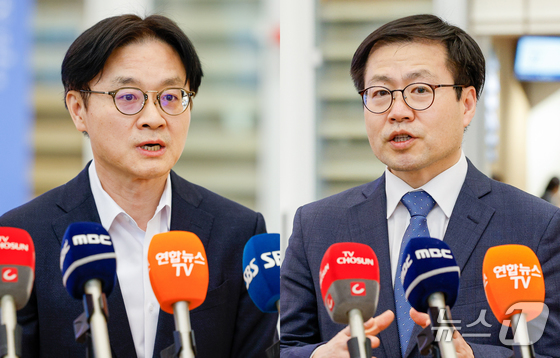
Minister of Trade, Industry and Energy Kim Jeong-gwan (left) and Trade Negotiations Director Yeo Han-koo returned to South Korea separately via Incheon International Airport Terminal 2 on the afternoon of March 8 after concluding consultations on pending trade issues with the U.S., answering questions from reporters 2026.3.8 / News1