

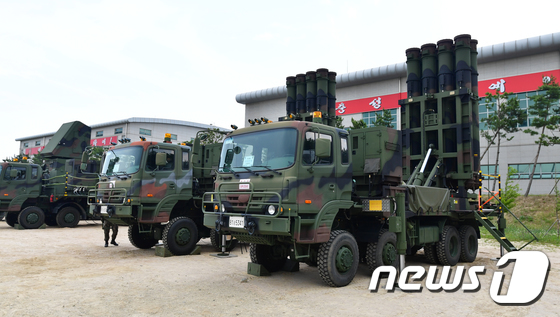
If Iran prolongs missile strikes against U.S. bases in the Middle East, analysts say Washington could redeploy air-defense assets from other theaters, including those protecting U.S. Forces Korea (USFK). That shift could trigger a global shortage of U.S.-made air-defense missiles and push standby orders toward South Korea’s medium-range Cheongung-II system.
Du Jin-ho, director of the Eurasia Center at the Korea Institute for National Strategy, told News1 on Wednesday morning that, when you consider the scale of U.S. air-defense batteries worldwide, the progress of operations such as the so-called Grand Fury campaign, and the defense requirements for the U.S. homeland and overseas bases, ground-based air-defense assets look increasingly stretched.
He said if Iran’s multi-directional sinking-ship tactics succeed and the conflict drags on—or if the U.S. is forced into an exit strategy—the U.S. military will likely have to pull together every available air-defense resource.
Du warned that if interceptor missiles run short, one option for the U.S. would be to shift the burden onto allies. That could mean redeploying U.S. air-defense assets from Korea and Japan to the Middle East.
He added allied nations would then have to cover the resulting gaps themselves. In that case, Seoul could either allocate more funding to buy additional Cheongung-II batteries or accelerate fielding of the long-range surface-to-air missile (L-SAM) system.
Du said the net effect would be to create the conditions for the strategic flexibility long sought by the Donald Trump administration.
Recent reporting indicates the U.S. has already moved Patriot (PAC-3) medium-range systems and Terminal High Altitude Area Defense (THAAD) high-altitude missile-defense assets from other regions—including the Indo-Pacific—to the Middle East. That redeployment includes systems based in South Korea.
Because the U.S., many European countries, Gulf states and several Asian nations operate Patriot batteries, a prolonged war with Iran that depletes U.S. and Gulf stocks could create a worldwide bottleneck in air-defense supplies.
A New York Times report on Monday found U.S. Patriot interceptor manufacturers produced roughly 620 missiles last year, while combined U.S. and Israeli strikes and subsequent regional use consumed more than 800 Patriot interceptors within days.
That scarcity has elevated interest in Cheongung-II, which reportedly recorded about a 96% interception rate in the United Arab Emirates (UAE).
Kim Man-gi, a professor in Korea Advanced Institute of Science & Technology (KAIST) Defense Export Development Program (DEDP), told reporters by phone that Middle Eastern countries have come to appreciate the critical role of interceptor systems during the conflict. He expects an export ecosystem for Korea’s missile-intercept systems to emerge in the Middle East and beyond—similar to how K2 tanks and K9 howitzers have developed follow-on ecosystems in Europe.
Kim urged that, beyond simple arms sales, Seoul pursue local co-production and technical cooperation to build a Cheongung-II air-defense network abroad.
He acknowledged Cheongung-II manufacturers cannot ramp up production overnight, but said now is the time to actively accept standby orders.
He said that backorders from various Middle Eastern countries will increase. If it accepts them, current delivery schedules of 12 months could stretch to 24 or 36 months. Even so, accepting backorders now is the right move.
He added that once backorders are accepted, Seoul and manufacturers must adjust delivery timelines and develop the supply chain to meet those commitments.