

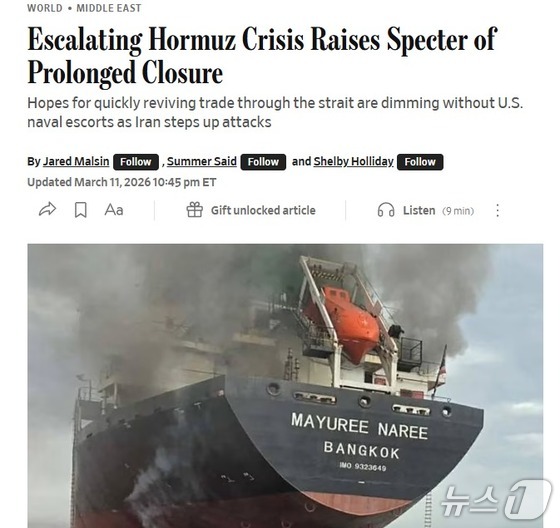
The Strait of Hormuz crisis has reached a boiling point, potentially leading to a protracted U.S.-Iran conflict, The Wall Street Journal (WSJ) reported on Wednesday.
Iran’s aggressive actions, including attacks on commercial vessels in the Strait of Hormuz and oil tankers in Iraqi waters, have intensified the Middle East crisis. In response to the escalating dangers, U.S. military forces have abandoned plans to escort merchant ships through the strategic waterway.
As a result, experts predict an unavoidable long-term blockade of the Strait of Hormuz, a crucial chokepoint through which 20% of the world’s oil transits.
Even after the blockade ends, normalizing operations will require substantial time.
The reopening of the strait will face significant challenges, with over 1,000 cargo vessels currently waiting, suggesting a prolonged period to clear the backlog.
Jerry Kalogiratos, Chief Executive Officer (CEO) of Athens-based Capital Clean Energy Carriers, drew a parallel with the Red Sea situation, stating that to look at the Red Sea, six months after the Houthi rebels halted their attacks, it is still not back to normal. The Strait of Hormuz will likely face a similar scenario.
An extended blockade of the Strait of Hormuz is expected to trigger a surge in oil prices, causing global economic turmoil and pushing the U.S. further into inflationary pressures.
This aligns with Iran’s strategic objectives. The Revolutionary Guard’s intelligence unit sent a nationwide text message, boasting that by controlling the Strait of Hormuz, Iran now possesses the power to influence the global economy.
The prolonged closure of the Strait of Hormuz is set to drive oil prices skyward. In Asian trading, Brent crude futures surged over 8%, breaching the 100 USD per barrel mark once again.
Consequently, the Donald Trump administration faces the daunting task of battling inflation. The WSJ noted that a primary factor in Joe Biden’s previous election loss was voter frustration with persistent inflation.