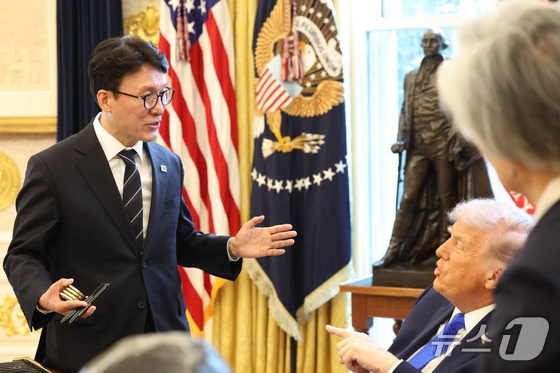
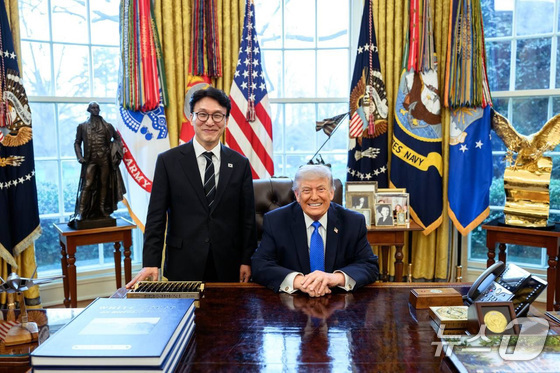
Prime Minister Kim Min-seok held an unexpected 20-minute meeting with U.S. President Donald Trump at the White House on March 13 to discuss ways to improve relations with North Korea.
During a press briefing at the Korean Cultural Center in Washington, D.C., Kim stated that he had a conversation with President Trump for about 20 minutes without an interpreter. Although it was their first substantial interaction, they spoke freely and comfortably.
Kim explained that this meeting was unplanned and spontaneous. He mentioned that he met with Trump after a meeting with Paula White, the head of the White House Office of Faith-Based and Neighborhood Partnerships.
Kim conveyed to President Trump that President Lee Jae Myung frequently refers to him as the only leader capable of resolving the Korean Peninsula issue.
Kim recounted that when he told President Trump that President Lee often speaks of him as the only leader who can resolve the Korean Peninsula issue, President Trump showed immediate interest in North Korea. He asked his aides to bring a photo of Kim Jong Un taken at Panmunjom, and they began discussing the matter.
He added that at that time, President Trump had just finished an important meeting with Defense Secretary Pete Hegseth and Chairman of the Joint Chiefs of Staff Dan Caine. When Kim mentioned that Lee is the only leader capable of resolving the Korean Peninsula issue, President Trump turned to them and asked, Did you all hear that? He then asked Kim to repeat it.
Kim noted that President Trump subsequently sought his opinion on North Korea.
He said that President Trump asked that he maintains a good relationship with Chairman Kim. Trump is curious if Chairman Kim wants to engage with the U.S. or him, and he asked for Minister Kim’s thoughts.
Kim responded that in reply to President Trump’s question, he shared several insights. He emphasized that President Trump is the only Western leader who has directly spoken with Chairman Kim, and he expressed his belief that Chairman Kim is uniquely positioned as a peacemaker to resolve the Korean Peninsula issue.
Additionally, Kim mentioned discussing the current situation in North Korea, the possibility of North Korea’s willingness to engage in dialogue with President Trump, and potential ways to advance that relationship. He noted that in response, President Trump immediately gave his aides several directives.
However, Kim added that it would be inappropriate for me to disclose the specifics of his instructions before the President himself chooses to reveal them.
Kim asked President Trump if he could deliver an English memo containing additional thoughts before leaving the U.S., and Trump agreed. He reported that he briefed President Lee on the details immediately after the meeting.
He did, however, provide some insight into the direction of the discussions. In a subsequent Q&A session, Kim explained that the memos to be sent to President Trump and Vice President JD Vance contained similar messages. He expressed the view that maintaining open channels of communication with North Korea, even if the chances seem slim, would be beneficial. He noted that recent statements from North Korea’s party congress, while maintaining their traditional stance, showed relative restraint in direct attacks against the U.S. or President Trump. He observed a slight shift in tone, saying that previously, they suggested there was no reason not to meet. Now, they’re implying that there’s no inherent reason for poor relations between them.
He continued that the memos for President Trump and Vice President Vance essentially contain the same content. I have specific ideas on potential solutions, but it’s not appropriate to share those details at this time.
Kim also shared President Trump’s remarks regarding the timing of U.S.-North Korea contacts, stating that President Trump said that meeting is good. Meeting is really good. It could coincide with his trip to China, or it might not. It could be later. This indicates that the exact timing isn’t the core issue, and my suggestion wasn’t aimed at rushing or linking the timing to any specific event.
He emphasized that whether the timing aligns with the China visit or not, the key point is that dialogue or contact should proceed. That seems to be President Trump’s fundamental belief.
Kim stressed that both President Trump and Vice President Vance showed genuine interest in the North Korean issue. He explained that while he initiated the conversation about being a peacemaker, it was the U.S. side that first brought up the topic of North Korea in their meetings.
He remarked that while he can’t determine the exact priority of the North Korean issue in U.S. foreign policy, it’s clear that it remains within their sphere of significant interest.
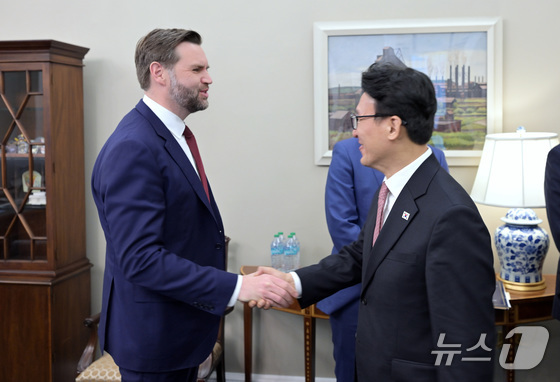
On March 12, Kim reported discussing U.S.-Korea issues with Vice President Vance. He addressed the passage of the Special Law on U.S. Investment in the National Assembly, Korea’s preliminary intentions regarding a major U.S. investment project, progress on the Google Maps issue, and cooperation on critical minerals.
Notably, Kim mentioned that U.S. Trade Representative Jamison Greer also attended the meeting with Vice President Vance. He reported that Vance and Greer acknowledged Korea’s efforts and progress in U.S.-Korea relations over the past 50 days.
Kim noted that Greer clarified that the Section 301 investigation is not specifically targeting Korea, and suggested that Korea might even find itself in a more favorable position than other countries in some aspects.
Kim also explained to both Vice President Vance and Greer the public sentiment and legal issues surrounding Coupang in Korea.
He stated that interestingly, Greer mentioned that in discussions about Coupang, she had been trying to steer the company away from adopting an aggressive stance that diverges from the core issues while addressing their legal challenges with the Korean government.
He added that he pointed out that although Coupang is legally an American company, its founder (Kim Bom-suk) is ethnically Korean. He asked for their understanding of the unique sentiment this creates among the Korean public.
He continued that he explained that Coupang initially downplayed the issues, delayed reporting, and distorted the essence of the problem.
He expressed that he emphasized that the same rules apply to all companies, regardless of their country of origin. The way Coupang has handled this situation, seemingly trying to frame it as a U.S.-Korea trade issue, has not been well-received by the Korean public. Kim suggested that if they had acknowledged and apologized early on, the emotional response might not have escalated beyond the actual penalties they face. He noted that while the U.S. officials didn’t directly respond to this point, they seemed to take it in.
He also mentioned Coupang’s recent withdrawal of its Section 301 petition, stating that this could be interpreted as them stepping back from one of their more aggressive approaches to resolving the issue.
Regarding digital regulation, Kim noted that the U.S. showed interest in Korea’s platform regulations, which they initially thought were similar to the European Union (EU) approaches. He clarified that the approach differs from the EU. It doesn’t regulate the platforms themselves; instead, it focuses on the individual users who cause issues. This is a fundamental difference from the EU model.
On the Special Law on U.S. Investment, Kim mentioned ongoing discussions about potential projects, including nuclear energy expansion. He indicated that one or two ideas are being seriously considered as flagship initiatives.
He also extended an invitation to Vice President Vance to visit Korea this year, or if not possible, to attend the World Youth Day (WYD) in Seoul next year. Kim reported that Vance expressed strong interest in visiting Korea.
During his visit, Kim also met with Michael Kratsios, the Director of the White House Office of Science and Technology Policy. They discussed cooperation on artificial intelligence (AI), biotechnology, and issues related to nuclear fuel enrichment and reprocessing mentioned in the recent U.S.-South Korea joint statement.
He reported receiving positive responses regarding collaboration on U.S. AI export support programs, the Biosecure Act, and nuclear and reprocessing technology cooperation.
When asked about potential requests for support regarding U.S. military operations against Iran, he replied that there were no specific discussions or requests for assistance in his meetings with President Trump or Vice President Vance on this matter.
Kim explained that the purpose of his second U.S. visit was to review diplomatic, trade, and security issues on behalf of President Lee, and to foster broader and more routine contacts with U.S. officials beyond formal ministerial-level discussions.
He also addressed the issue of religious freedom, which has been of interest to U.S. officials, during his meetings with Vice President Vance and White.
He explained the differences between the U.S. and Korea in terms of church-state relations, noting that while the White House has an office dedicated to faith-based initiatives, Korea does not have an equivalent structure due to different political and cultural contexts.
Kim mentioned that during his meeting with White, questions arose about the cases of Pastor Son Hyun-bo and Unification Church leader Hak Ja-han. He clarified that these cases involve violations of election laws, political funding regulations, or bribery statutes. They apply equally to religious and non-religious individuals alike. He emphasized that he provided a detailed explanation of these points.