

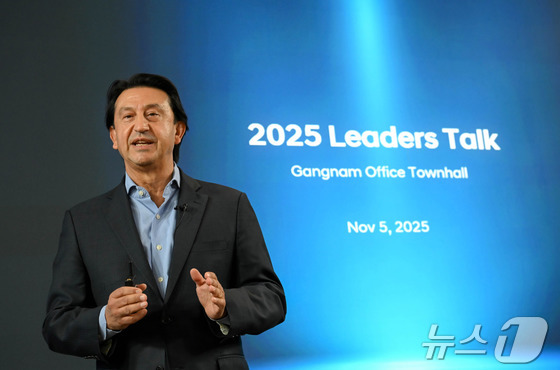
On Thursday, Jose Munoz, President and Chief Executive Officer (CEO) of Hyundai Motor Company, announced plans to accelerate the company’s transformation into an artificial intelligence (AI) centric technology firm, focusing on autonomous driving and physical AI, while also strengthening localization efforts.
Speaking at the 58th annual shareholders’ meeting at the company’s headquarters in Seoul, Munoz stated that it aims to evolve beyond a mere vehicle manufacturer into a company that creates intelligent systems for production and mobility.
Munoz revealed plans to deploy Boston Dynamics’ Atlas robot in actual production sites and establish a robot production system capable of manufacturing 30,000 units annually by 2028. He emphasized that through partnerships with Google DeepMind and Nvidia on physical AI infrastructure, it intends to secure a dominant position in the technological ecosystem.
The CEO highlighted the acceleration of autonomous driving technology development to offer innovative driving experiences across a broader range of vehicles. He cited collaborations with Nvidia, investments in 42dot and Motional, partnerships with Waymo, and the establishment of AI data centers in South Korea as key initiatives to bolster technological competitiveness.
Regarding localization strategies, Munoz announced the commencement of full-scale operations at Hyundai’s new U.S. factory and the start of domestic hybrid electric vehicle (HEV) production. He underscored plans to strengthen local production by establishing new manufacturing bases in India, Saudi Arabia, and Vietnam. Munoz added that by 2030, it aims to expand the global production capacity by 1.2 million units annually to mitigate trade risks.
In China, Hyundai plans to launch 20 new models over the next five years, including a new electric sedan this year, targeting annual sales of 500,000 units. The company will introduce five new models in Europe over the next 18 months.
For India, Hyundai has outlined plans to introduce 26 new models over the next decade and is exploring a Genesis brand launch next year. In North America, the company will release updated versions of the Tucson and Elantra this year, followed by a range-extended electric vehicle (EREV) boasting over 600 miles (about 965 km) of range, slated for 2027.
Reflecting on last year’s performance, Munoz reported global sales of 4.14 million units and record annual revenue growth of 6.3% compared to the previous year. He noted that at the group level, it ranked third in global sales and second in profitability.
Munoz emphasized three significant shifts in Hyundai’s global perception over the past year. He highlighted the meeting between Hyundai Motor Group Executive Chair Chung Eui-sun , Nvidia CEO Jensen Huang, and Samsung Electronics Chairman Lee Jae-yong as a pivotal moment, positioning Hyundai at the forefront of global AI innovation.
Munoz stated that they’ve bolstered the leadership in future mobility technology by appointing Manfred Harrer as head of research and development (R&D) and bringing in Dr. Park Min-woo. The upcoming AI robotics strategy unveiling at the Consumer Electronics Show (CES) 2026, featuring Boston Dynamics’ Atlas, will solidify Hyundai’s position as a leader not just in vehicle manufacturing, but in robotics, autonomous driving, and AI.