

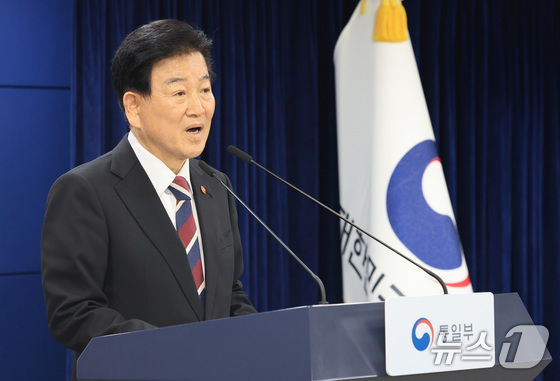
The Ministry of Unification has announced plans to revise the Regulations on Inter-Korean Humanitarian Projects and Cooperation Projects, expanding the scope of support from the Inter-Korean Cooperation Fund. Notably, the ministry has replaced the term support with projects, a move seemingly aimed at addressing North Korea’s aversion to aid.
On Friday, the Ministry of Unification revealed that it had publicly announced the proposed revisions on March 19 and is currently gathering public input on the reasons for the changes and key details.
The core of this revision is the restructuring of the existing humanitarian aid projects for North Korea into inter-Korean humanitarian projects and cooperation projects. The ministry plans to align with international humanitarian aid standards by refining the scope of humanitarian projects into categories such as food security, healthcare, water and sanitation, forest restoration, and climate crisis response.
The approval process for cooperation projects has also been clarified. Project proposals must now include detailed information on the initiative’s background, funding plans, and expected outcomes. Additionally, documentation confirming the final agreement with North Korea and the project execution structure is required. A notable strengthening of the rules involves the need for guarantees of project implementation and facilitation of personnel exchanges, to be confirmed by North Korean authorities or credible institutions.
Conversely, the criteria for support from the Inter-Korean Cooperation Fund have been relaxed. The ministry has increased the frequency of support from once to three times annually and raised the support limit from 50% to a maximum of 90% of total project costs. This change aims to boost private sector participation and enhance project sustainability. The ministry has also set a 20-day limit for project approval processing to improve procedural predictability.
Simultaneously, management requirements have been significantly tightened. The revised regulations mandate that funded projects ensure distribution transparency through North Korea visits and personnel deployment. They also require the submission of evidence such as delivery receipts, distribution records, site visit reports, and beneficiary interview results.
The revisions exclude one-time support projects, initiatives with limited field access, and those aimed at economic profit from eligibility. Criteria for suspending or recovering funds in cases of misuse have been clarified. Fund execution will generally follow a post-settlement approach, with quarterly performance reports and separate accounting management required.
The ministry has also established the groundwork for an electronic information system to register project outcomes and has updated information disclosure regulations. While project details and execution records will be publicly available through the National Treasury Subsidy Management System, provisions for non-disclosure in certain circumstances have been included.
Previously, in November 2023, the Ministry of Unification had reduced support for private organizations from three times to once annually and lowered the support limit from 70% to 50% of total project costs, reflecting the strained inter-Korean relations.
This latest revision, coming after a two-and-a-half-year hiatus, appears to be part of the Lee Jae Myung administration’s conciliatory approach, aiming to expand engagement with North Korea.