

The inter-Korean relationship is expected to remain frosty and disengaged for the foreseeable future, as North Korea maintains its stance as a hostile nation. However, military analysts caution that tensions could spike in response to Pyongyang’s repeated threats to redraw the border between the two Koreas.
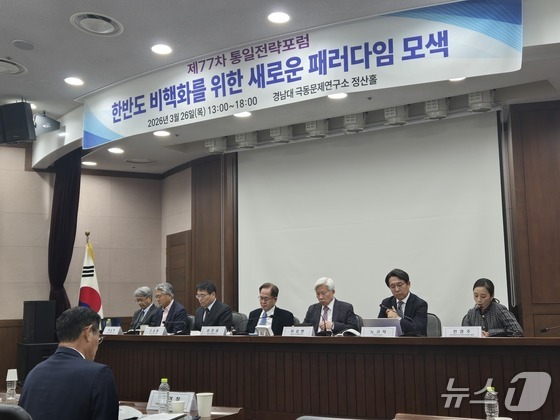
Speaking at the 77th Unification Strategy Forum hosted by Kyungnam University’s Institute for Far Eastern Studies in Seoul on Thursday, Choi Yong-hwan, deputy director at the National Security Strategy Institute, argued that North Korea has been crafting its foreign policy around a new Cold War paradigm since the 8th Congress of the Workers’ Party in 2021.
Choi explained that the core of this strategy involves leveraging strained U.S.-China and U.S.-Russia relations, exacerbated by strategic competition and the Ukraine conflict, to strengthen ties with Beijing and Moscow as a bulwark against pressure from Washington and the international community.
In the wake of Russia’s invasion of Ukraine, North Korea has proclaimed itself central to the creation of a fair and just multipolar world. Choi interprets this rhetoric as evidence of Pyongyang’s alignment with Moscow’s worldview, suggesting that North Korea-Russia relations will endure beyond the current conflict.
Given the supreme leadership’s absolute control over all aspects of North Korea’s regime, Choi noted the unusual emphasis placed on direct leadership and engagement of the Party Central Committee in foreign affairs at February’s 9th Party Congress. He believes this signals Pyongyang’s recognition of increasing global volatility and a corresponding push for greater flexibility and responsiveness in its foreign policy.
However, Choi warned that during periods of heightened political and military tension, North Korea might resort to nuclear coercion tactics.
The expert highlighted how global conflicts have accelerated the arms race, while key arms control treaties like the Intermediate-Range Nuclear Forces Treaty (INF) and New Strategic Arms Reduction Treaty (START) have been effectively gutted. These factors, he argues, will make resolving the North Korean nuclear issue even more challenging.
Choi cautioned that ignoring North Korea’s nuclear and strategic weapons development could exacerbate the security dilemma, fueling an arms race on the Korean Peninsula and surrounding regions.
In a separate analysis, Jo Sung-ryul, visiting professor of Military Studies at Kyungnam University, asserted that South Korea’s strategy for peaceful coexistence hinges on effectively managing North Korea’s nuclear capabilities. Jo posited that Pyongyang faces a critical choice: remain a nuclear-armed but economically impoverished nation reliant on self-sufficiency, or pursue a path as a nuclear-free developing country with regime security guarantees.
Jo predicted that North Korea is likely to insist on framing any dialogue in terms of nuclear disarmament negotiations or arms control between sovereign equals, rather than denuclearization.
He concluded by characterizing the Korean Peninsula’s security structure as a longstanding trilemma, with three conflicting goals: strengthening the U.S.-South Korea alliance, denuclearizing the peninsula, and establishing a lasting peace regime.