

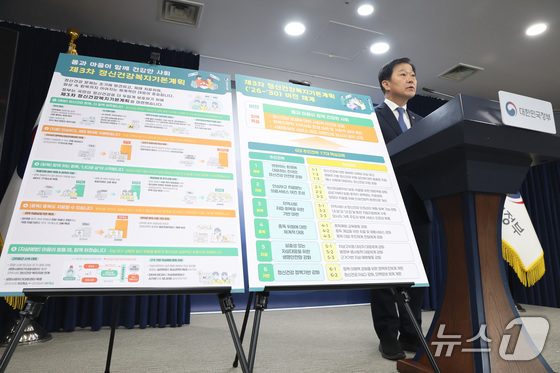
The government will pilot the introduction of “emergency mental health control centers” to support hospital bed allocation and patient transfers, while strengthening public responsibility in involuntary admission and treatment procedures as part of efforts to bolster mental health care and recovery infrastructure.
It will also introduce artificial intelligence (AI) technology to monitor suicide-inducing content online in real time, 24 hours a day, and review appropriate reimbursement rates reflecting the complexity of addiction treatment, as part of efforts to enhance addiction treatment and prevention systems.
The Ministry of Health and Welfare announced on the 27th that it had finalized and unveiled the “Third Basic Plan for Mental Health Welfare” (2026–2030) following deliberation by the Health Promotion Policy Committee.
While the government has expanded infrastructure through measures such as psychological counseling vouchers and broader mental health screenings, it established the plan in response to rising prevalence of mental illness and increasing addiction and suicide rates, particularly among younger populations.
Under the vision of “a society where both body and mind are healthy,” the ministry will pursue 17 key tasks across six areas: prevention, treatment, recovery, addiction, suicide and infrastructure.
Pilot introduction of emergency mental health control centers… expansion of regional emergency centers
For prevention, the government will strengthen psychological counseling for high-risk groups, including those vulnerable to depression and anxiety, suicide attempt survivors and disaster victims, while introducing in-home and remote counseling services for individuals with mobility challenges and those in underserved areas.
For children and adolescents, emergency response teams—comprising psychiatrists and other specialists—will visit schools to support at-risk students, with the number of teams increasing from 56 to 100 by 2030.
For young adults, vulnerable groups will be identified through national health screenings and military physical examinations, while first-time psychiatric consultation fees will be subsidized.
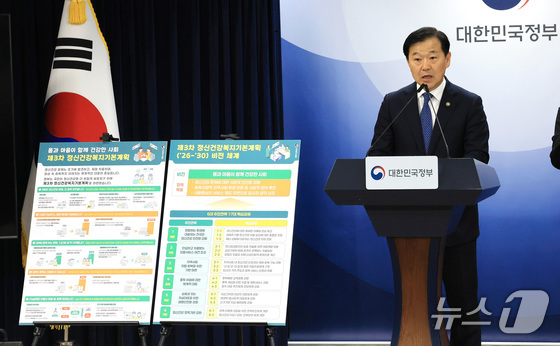
To strengthen treatment services, the number of regional emergency mental health centers capable of providing 24-hour care through collaboration between psychiatry and emergency medicine departments will be expanded from 13 to 17 by 2030.
Public hospital beds will be increased, particularly at general hospitals capable of treating both physical and psychiatric conditions, and some intensive care unit beds will be designated as emergency beds.
A provisional “emergency mental health control center” will also be piloted to provide real-time bed availability information through a shared system for psychiatric emergency beds, enabling systematic support for appropriate bed allocation and patient transfers.
Intensive care beds with enhanced facilities and staffing will be expanded from about 400 to 2,000.
The government will also consider introducing advance directives to reflect patient preferences during treatment.
Pilot programs will be launched to strengthen public responsibility in involuntary admission processes—including patient transfers and treatment cost support—with the goal of improving admission and discharge procedures by 2030.
To support community-based independence and recovery, the government will establish suitability indicators to facilitate functional transitions of psychiatric care facilities, while converting unsuitable facilities into smaller group-living arrangements.
To expand regional rehabilitation infrastructure, rehabilitation services will be linked with integrated care programs, and pilot work-experience programs will be introduced to strengthen patients’ economic participation and housing support.
Review of specialized drug treatment clinics… psychological autopsies expanded to adolescents
The government will expand infrastructure for drug addiction treatment. The number of regional treatment and protection centers will increase from nine to 18 next year, and designation of specialized addiction treatment clinics for mild cases in communities will be reviewed.
It will develop appropriate reimbursement systems reflecting treatment complexity, conduct regular surveys on narcotics and alcohol addiction, and establish standardized treatment guidelines and severity assessment systems for tailored care.
A centralized function overseeing addiction policies—currently dispersed across multiple ministries—will be established to strengthen coordination, alongside efforts to enact a framework law covering institutional, administrative and financial systems.
To respond to suicide, the government will develop an emergency response model for mental health and suicide crises, including 24-hour monitoring of urgent suicide-related information.

The government will revise the Suicide Prevention Act to link information on suicide attempt patients visiting emergency rooms with local governments and expand one-stop support for bereaved families, including psychological counseling, temporary housing and legal assistance.
Psychological autopsies analyzing causes of suicide will be expanded from adults to adolescents, and AI-based analysis will be introduced to the suicide prevention hotline “109” to detect early warning signals.
In line with amendments to the Suicide Prevention Act set to take effect in November, the government will establish systems to monitor and respond to online suicide-inducing content using AI, while working with stakeholders to manage the distribution and sale of harmful items such as charcoal briquettes.
Additionally, the ministry will consider establishing a “Mental Health Policy Committee” to enhance interagency cooperation and designate “suicide prevention officers” within local governments to oversee related efforts.
Lee Hyung-hoon, second vice minister of Health and Welfare, said, “The third Basic Plan for Mental Health Welfare serves as a blueprint for government mental health policy over the next five years,” adding that “depression and anxiety are experiences that anyone can face.”
He added, “We will reduce social stigma so that people can feel understood in their emotional struggles, while strengthening the mental health safety net to ensure that everyone can seek treatment with peace of mind.”