

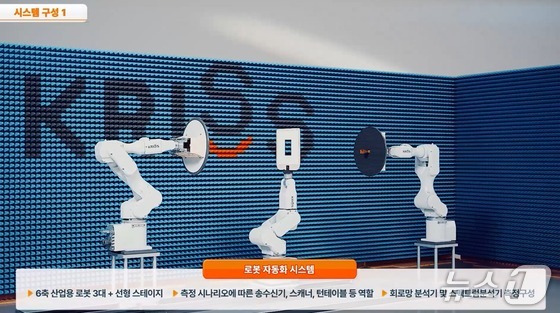
On Tuesday, the Korea Research Institute of Standards and Science (KRISS) unveiled its independently developed robot-based ultra-precision electromagnetic measurement system. This innovative system, built on proprietary design and control technologies, is poised to revolutionize applications in defense, next-generation communications, and semiconductor industries.
In recent years, the electromagnetic spectrum utilized in cutting-edge communication components, semiconductor package antennas, and aircraft radar systems has expanded significantly. High-frequency bands above tens of gigahertz (GHz) pose unique challenges due to their short wavelengths. Even slight misalignments in measurement targets can lead to drastically different results, underscoring the critical need for advanced precision measurement techniques.
KRISS researchers have pioneered a groundbreaking approach by integrating robotic technology that allows for both flexible and precise control of electromagnetic measurement devices and target positioning. This goes far beyond the mere application of off-the-shelf robots. The team has built a comprehensive ultra-precision electromagnetic measurement platform, developing everything from system design to control software and position correction algorithms in-house.
The new system harnesses six degrees of freedom (6-DOF) robotic technology, enabling movement across all axes and rotation. This versatility allows for measurements across an expansive electromagnetic spectrum, reaching up to 750 GHz.
A standout feature is the implementation of state-of-the-art position measurement and correction technology. This innovation has pushed antenna alignment error control to world-class levels, achieving precision within 10 micrometers (µm) – a mere one-hundred-thousandth of a meter. To put this in perspective, it’s about one-seventh the width of a human hair, significantly boosting measurement reliability in high-frequency bands where even minute discrepancies can skew results.
Moreover, the system’s adaptable robotic mobility overcomes traditional spatial and economic constraints. Conventional large-scale electromagnetic testing facilities typically require vast spaces and involve substantial setup costs.
In contrast, the KRISS system employs a novel approach where the robot precisely navigates around the target object. This method enables high-precision testing to be conducted repeatedly in compact spaces, dramatically reducing costs.
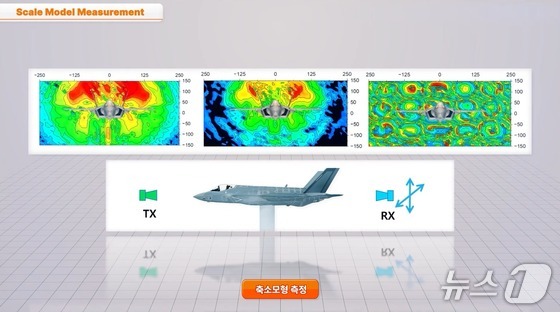
The research team emphasized the system’s particular significance in evaluating defense sector weapon systems. During the development phase of these systems, even minor shape and position errors in electromagnetic scattering assessments using scaled models can have outsized impacts when extrapolated to full-scale scenarios.
KRISS’s ultra-precision control technology minimizes errors in electromagnetic measurements for scaled models, thereby enhancing the overall quality and reliability of defense technologies.
By developing both the system design and control software in-house, KRISS has created a highly adaptable platform. This flexibility allows for customized control and monitoring software tailored to various industrial applications. The system can be fine-tuned for complex-shaped aircraft radars, phased array antenna modules requiring ultra-precise control, and semiconductor antennas, adapting to the unique characteristics of each measurement target.
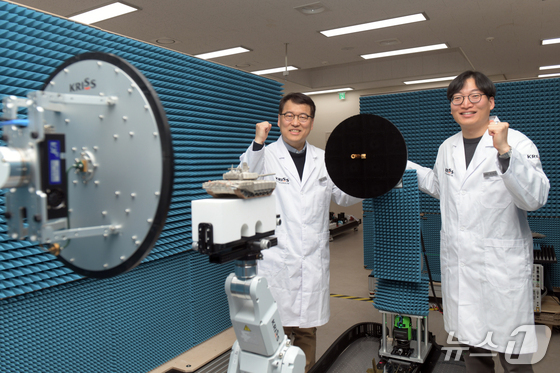
Dr. Jae-yong Kwon, lead researcher of the electromagnetic measurement group, highlighted that this breakthrough combines the agile mobility of robotics with KRISS’s proprietary precision control technology, overcoming limitations inherent in traditional fixed measurement methods. Looking ahead, the team plans to integrate AI to further advance electromagnetic measurement technology in critical national strategic sectors such as defense, semiconductors, and next-generation communications.
This research was supported by the Ministry of Science and Information and Communications Technology’s (ICT) National Research and Development Programs and KRISS’s Basic Research Program. The findings have been published in the prestigious international journal Composites Communications and received the Best Antenna Measurement Paper Award at the International Forum for Sustainable Asia and the Pacific (ISAP) 2024 international conference, underscoring its global significance in the field.