

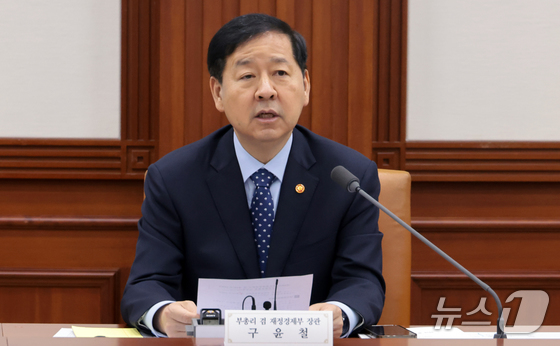
Deputy Prime Minister and Finance Minister Koo Yun-cheol announced on Monday that South Korea will strategically respond to the ongoing Section 301 investigation by the U.S., which aims to impose tariffs.
During a meeting at the Government Complex in Seoul, Koo emphasized that the administration will spare no effort to protect Korean companies’ interests through ongoing dialogue and consultation with U.S. officials.
The U.S. government officially launched the investigation under Section 301 through the Federal Register on March 11.
Washington justified this move by alleging that major trading partners have built production facilities unrelated to market demand, resulting in persistent trade surpluses that pose a threat to American industries.
Specifically, they singled out South Korea for maintaining a trade surplus, primarily through exports of electronic equipment, automobiles, and ships.
As the investigation could potentially lead to new tariffs on South Korea, the government has established a public-private joint task force to address Section 301 concerns, gathering input from industry stakeholders and developing a comprehensive response strategy.
Koo stressed that, contrary to U.S. assertions, South Korea’s manufacturing sector is operating at appropriate capacity levels. He pledged to actively highlight how Korean capital goods exports contribute to the revitalization of U.S. manufacturing.
The U.S. is also investigating the ban on imports of products made with forced labor.
The U.S. government has identified South Korea as a country that does not prohibit the import of goods produced with forced labor, specifically citing the issuance of a Withhold Release Order (WRO) on salt produced at the Taean salt farm in South Jeolla Province.
Seoul plans to address U.S. concerns by emphasizing its compliance with International Labour Organization (ILO) conventions and adherence to the Korea-U.S. Free Trade Agreement (FTA).
Koo stated that South Korea has a robust framework based on ILO conventions and domestic laws prohibiting forced labor. It intends to convey our rigorous approach to this issue.