

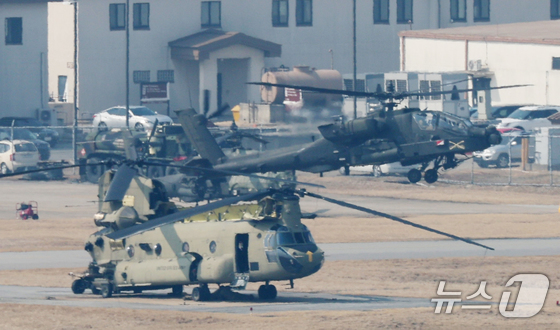
North Korea has issued a stark warning on Thursday in response to the U.S.’s recent decision to sell over 6 trillion KRW (about 3.95 billion USD) worth of military equipment to South Korea. This sale, which includes multi-purpose helicopters and Apache upgrade programs, has been labeled by Pyongyang as a significant regional security challenge that demands a symmetrical response.
The Korean Central News Agency (KCNA) published a commentary titled, U.S.-South Korea Military Buildup Will Intensify Our Deterrence Efforts, criticizing Washington’s arms sales to its allies in South Korea and Northeast Asia. The statement asserts that these actions have evolved into a major regional security threat that cannot be ignored.
This reaction follows the U.S. State Department’s announcement on Monday approving a Foreign Military Sale (FMS) of 24 MH-60R multi-purpose helicopters and associated weaponry to South Korea. Pyongyang’s response indicates strong opposition to this move.
The KCNA emphasized that this approval underscores both U.S. arms exports and South Korea’s aggressive military expansion. It accused Washington of using Seoul as a vanguard to achieve strategic dominance in the Asia-Pacific region.
The commentary warned that unilateral military buildups exceeding defensive needs will inevitably trigger reciprocal measures from opposing forces. It stressed that parties pursuing such buildups should expect proportional responses, not indifference, from their adversaries.
A North Korean foreign ministry spokesperson, responding to a KCNA reporter, stated that U.S. arms proliferation is the primary cause of military tensions in the Korean Peninsula and Taiwan Strait, forecasting an unstable regional security outlook.
The KCNA concluded by asserting that South Korea’s irrational military expansion ambitions reflect the current U.S. administration’s new military strategy. This strategy, they claim, aims to ensure flexible strike capabilities against rival nations across the Asia-Pacific. The statement emphasized that North Korea’s defense capabilities would effectively counter all security threats from adversarial countries.