

South Korea’s biologics contract development and manufacturing organization (CDMO) market has traditionally viewed manufacturing scale as a key competitive advantage. However, the landscape is changing, with development expertise and customized services emerging as equally important differentiators.
PanGen is positioning itself as a “development-focused CDMO,” saying its strength lies not only in manufacturing for clients but also in supporting the development of new drugs and biosimilars based on its own experience developing and commercializing biosimilar products.
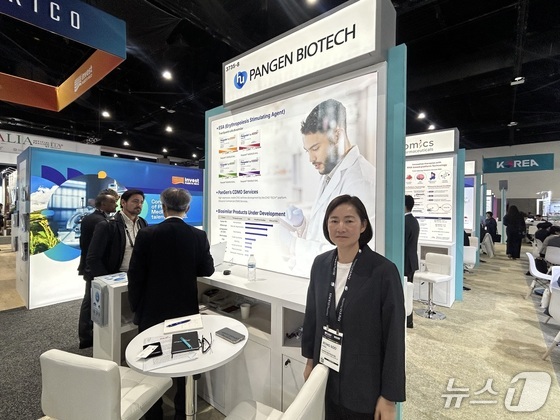
At the BIO International Convention held last month at the San Diego Convention Center in California, PanGen Research Center Head Park Jung-soo, an executive director, told News1, “There is a difference in customer trust between companies that only have technology and companies that have actually developed products.” He added, “Because PanGen has experience developing and selling biosimilars, we can help solve issues that arise throughout the development process.”
PanGen provides the full range of CDMO services, from cell line development and process development to production of nonclinical and clinical trial materials. The company also highlights its ability to provide development strategy planning, regulatory support and technology transfer consulting as key strengths.
“From a client’s perspective, there can be concerns over whether a technology can actually lead to a commercial product,” Park said. “Because we have experience launching products, we can provide practical support throughout the entire development process.”
The company has conducted cell line development projects for external pharmaceutical companies in addition to developing its own biosimilar products. PanGen said inquiries have recently increased from companies seeking joint development partnerships involving its internally developed biosimilar candidates.
Another strength PanGen emphasizes is its “customer-tailored development” approach.
While large global CDMOs provide standardized services based on large-scale manufacturing facilities, PanGen focuses on optimizing processes together with customers during the early stages of development.
“Because every biologic protein has different characteristics, producing them through a fixed process does not always lead to optimal results,” Park said. “PanGen takes an approach of continuously communicating with customers and developing processes together.”
He added, “A 500-liter production facility may appear small compared with large CDMOs, but it is the most efficient scale for producing clinical trial materials. It can also reduce cost burdens for early-stage development companies.”
Since becoming part of Huons Group, PanGen has served as a key pillar of the group’s biotechnology business. The company continues to participate in group biotechnology projects, including Huons Lab’s hyaluronidase program, where PanGen is responsible for cell line development and clinical material production.
“As collaboration with Huons Group expands, our CDMO business is naturally growing as well,” Park said. “The combination of the group’s research and development capabilities with PanGen’s manufacturing technology is creating synergies.”
PanGen’s proprietary pipeline is also advancing. The company currently sells an erythropoietin (EPO) biosimilar in eight countries and is pursuing expansion into Europe. At the same time, three antibody biosimilar candidates have completed cell line development and entered the process development stage.
The company has also recently continued discussions on joint development projects with major South Korean pharmaceutical companies. Changes in biosimilar regulations have created an environment where some products may be eligible for exemptions from Phase 3 clinical trials, potentially reducing development timelines and costs.
“In the future, we plan to create a structure where our proprietary biosimilar business and CDMO business drive growth together,” Park said. “Our experience developing products will ultimately become our greatest competitive advantage in the global market.”