

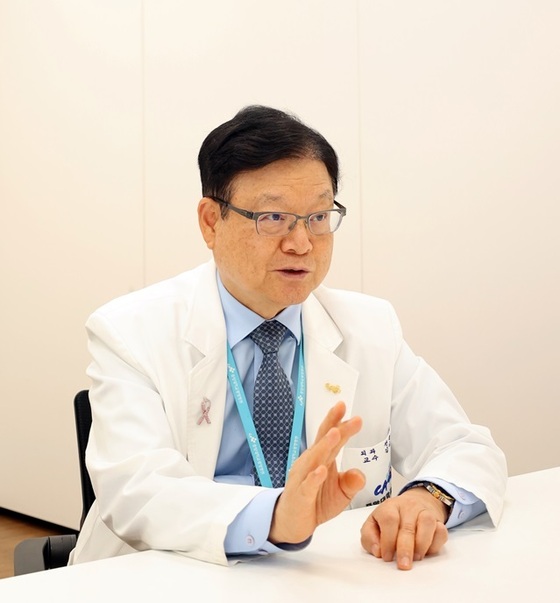
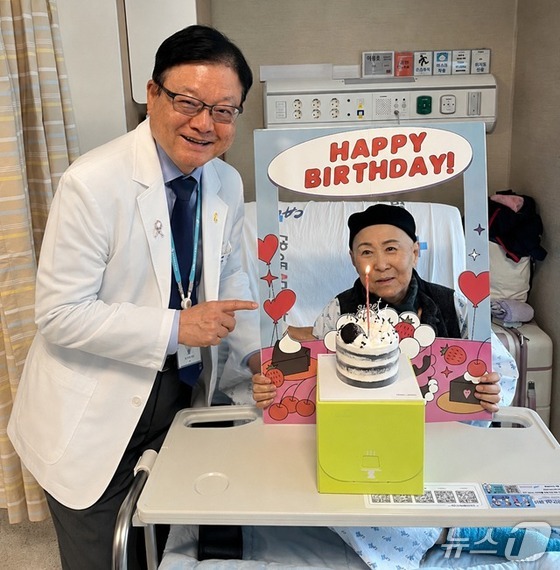
A patient sits alone in a cold hospital room, facing harsh chemotherapy and surgery while spending her birthday in isolation. Then, medical staff walk in wearing cone-shaped party hats and carrying a cake. The team sings a loud birthday song to the confused patient in an unprecedented celebration. The person behind the event is none other than Kim Yi-soo, director of the Cancer Hospital at Chung-Ang University Gwangmyeong Hospital.
“Patients are moved to tears by such a small gesture. Seeing that also brings tears to my eyes. Doctors are not machines that simply remove cancer cells. A true doctor must also embrace and heal the emotional wounds of patients.”
Kim is a leading figure in South Korea’s surgical community, having performed more than 50,000 surgeries throughout his career, including 16,000 breast and thyroid cancer surgeries. He is particularly recognized for introducing neoadjuvant chemotherapy in South Korea for the first time and establishing the concept of sentinel lymph node biopsy, which minimizes axillary (underarm) lymph node dissection, changing the paradigm of breast cancer treatment.
Beyond his surgical expertise, he is better known among patients as a “warm-hearted doctor.” He still remembers as one of his most meaningful gifts a jar of radish kimchi made by an elderly patient from radishes she personally grew in her field. After wearing a doctor’s coat for more than 40 years and remaining on the front lines of medicine, he continues to wake up early every morning and perform 12 surgeries a week.
The Cancer Hospital at Chung-Ang University Gwangmyeong Hospital, which he leads, reflects this warm yet dynamic philosophy. The hospital focuses on reducing patient anxiety by designing its treatment and testing systems around patients, including shortening waiting times. Kim shared his unwavering philosophy of treating patients’ lives rather than just cancer cells, along with stories from the front lines of care.
-
When people think of surgeons, they often imagine a cold and reserved image, but your approach has been very personal and unique.
▶ I did not do anything extraordinary. How lonely and frightening must it feel to spend your birthday in a hospital? When nurses and I celebrate with patients during rounds, the atmosphere in the room changes immediately. The most important thing is giving patients confidence that they can overcome their illness if they continue to fight. This is something that does not appear in medical textbooks. It started naturally from the heart.
-
Perhaps because of your dedication to patients, the five-year survival rate among patients you treated has reached 98.2%.
▶ A 98.2% survival rate is among the highest results globally, but what truly matters is the life patients live afterward. Some breast cancer patients can experience recurrence even 10 years or more after treatment, which makes long-term follow-up care essential, including consistently taking medication, undergoing regular checkups and maintaining healthy lifestyle habits.
What is important here is trust, or rapport, between doctors and patients. Surprisingly, there are not a few patients who stop taking medication because it is difficult or secretly discard it. That is why I often give patients advice and spend a lot of time talking with them during outpatient visits. Helping patients follow their treatment plans and prescriptions by improving medication adherence is also one of the doctor’s key responsibilities.
-
When discussing breast cancer treatment, you highlighted three key concepts: de-escalation, tailored treatment and precision medicine. How are these being implemented in actual clinical settings?
▶ These three concepts are the most important keys to explaining the current direction of breast cancer treatment. Doctors first analyze each patient’s cancer with precision, select the most appropriate tailored treatment based on the results and then reduce unnecessary surgeries and chemotherapy through de-escalation.
In the past, because doctors knew less about cancer, they believed wider and larger surgeries were necessary for a cure. Patients underwent total breast removal and complete removal of underarm lymph nodes. As a result, even patients who survived cancer often suffered from complications such as lymphedema, where their arms became severely swollen and difficult to use.
Today, removing more tissue is no longer considered the ideal approach. The focus is on maintaining treatment effectiveness while reducing the burden and suffering experienced by patients.
In the past, all breast cancer patients received standardized chemotherapy, but today treatment strategies must be carefully designed based on each patient’s cancer subtype and genetic characteristics, like a suit tailored specifically for an individual. A representative example is multigene testing. Previously, even patients with a low risk of recurrence often underwent intensive chemotherapy due to uncertainty. Now, precision analysis can identify low-risk patients who may safely avoid chemotherapy and receive only hormone therapy. Meanwhile, high-risk patients receive more aggressive chemotherapy and targeted treatments to reduce recurrence rates. With precise diagnosis, safer treatment reduction and truly personalized care have become possible.
-
You introduced neoadjuvant chemotherapy and sentinel lymph node biopsy for the first time in South Korea. It must have been a difficult decision at the time.
▶ Whenever new treatments were introduced, there were always concerns and opposition within the medical community. However, neoadjuvant chemotherapy allows many more patients to preserve their breasts by reducing tumor size before surgery. Sentinel lymph node biopsy is also an innovation that reduces unnecessary removal by checking only the lymph nodes where cancer is most likely to spread first.
In the past, even minimal evidence of cancer spreading to underarm lymph nodes resulted in complete removal. Today, strong evidence has shown that if there are only one or two affected lymph nodes, combining chemotherapy and radiation therapy can be sufficient. Treatment will continue moving toward further reduction. If the effectiveness is the same, there is no reason to force patients to endure greater suffering. Medicine must ultimately advance in a direction that reduces the burden on patients.
-
The number of young breast cancer patients has recently increased noticeably. Should treatment approaches also be different?
▶ The number of younger patients is increasing due to Westernized diets and obesity. These patients have much longer lives ahead after treatment. Many are planning marriage, pregnancy and childbirth, while also continuing their careers. Therefore, treatment cannot simply end with removing cancer cells. Preserving fertility is essential during treatment, and through close multidisciplinary collaboration with obstetrics and gynecology specialists, we consider the future of young women by offering options such as egg freezing before chemotherapy and ovarian protection injections.
Young patients also have relatively higher rates of aggressive triple-negative breast cancer and hereditary breast cancer. If a breast cancer-related genetic mutation is present, the risk of ovarian cancer also increases, requiring a long-term prevention and management plan. Breast cancer is not a disease that ends with one surgery; it is a condition that requires managing a patient’s entire life.
-
The Cancer Hospital at Chung-Ang University Gwangmyeong Hospital’s “one-stop” system has also drawn significant attention among patients.
▶ The most painful part for cancer patients is waiting. While waiting for test results and surgery dates, patients’ anxiety continues to grow. When we opened the cancer hospital, the first issue we considered was how to reduce this waiting period.
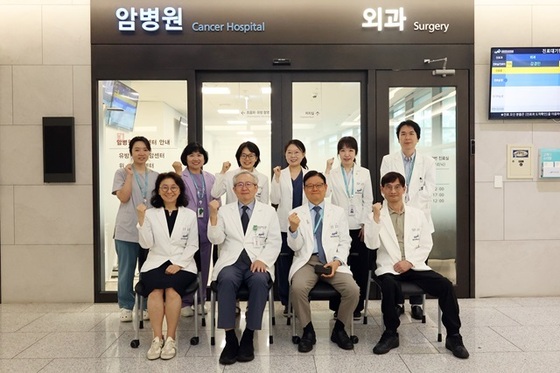
We operate a rapid treatment system that completes everything from biopsy and result confirmation to surgery scheduling within about one week, allowing surgery within three weeks after the outpatient visit. This minimizes patient anxiety and reduces delays in treatment. This system is possible because surgery, hematology-oncology, radiology, pathology and radiation oncology departments work together as a coordinated multidisciplinary team centered around surgery.
-
Finally, what direction will the Cancer Hospital at Chung-Ang University Gwangmyeong Hospital pursue moving forward?
▶ Since opening, our cancer hospital has achieved remarkable growth in a short period of time, but we are now preparing for a “second leap forward.” We have finalized plans to expand equipment and facilities to further reduce waiting times for imaging tests such as MRI, which patients are often most anxious about.
We will firmly establish ourselves as a leading cancer treatment center representing the southwestern metropolitan area.
However, a good cancer hospital is not one that simply performs a large number of surgeries. It is a hospital that patients trust most and one that takes responsibility for their lives until the moment they return to everyday life. Our goal is to create a hospital where patients complete treatment and say, “I’m truly glad I came here.”