

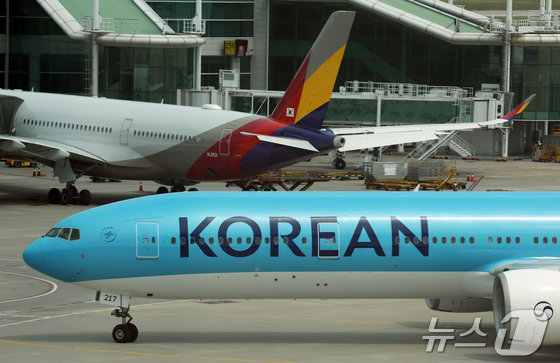
Korean Air and Asiana Airlines have increased their international fuel surcharges for September, marking the first hike in four months due to rising global oil prices. As a result, round-trip fares to the United States will see a spike of approximately 190,000 KRW (about 136 USD) compared to this month.
On Tuesday, both airlines announced updated fuel surcharges for international flights departing from South Korea, effective September 1-30. The surcharges, which vary by route and distance, range from 48,000 KRW (about 35 USD) to 354,000 KRW (about 254 USD) for Korean Air and 52,000 KRW (about 37 USD) to 291,000 KRW (about 209 USD) for Asiana Airlines.
These new rates represent increases of 36% for Korean Air and 42% for Asiana Airlines compared to current surcharges. Consequently, travelers can expect to pay an additional 189,600 KRW (about 136 USD) for East Coast routes and 199,800 KRW (about 143 USD) for Western Europe and West Coast routes on Korean Air. Asiana passengers will see an extra 174,400 KRW (about 125 USD) tacked on for Western Europe and U.S. routes.
For September, Korean Air’s surcharges will be as follows: 48,000 KRW (about 35 USD) for short Northeast Asian routes like Fukuoka and Qingdao; 66,000 KRW (about 47 USD) for major Northeast Asian destinations such as Tokyo and Beijing; 153,000 KRW (about 110 USD) for Southeast Asian cities including Bangkok, Singapore, and Ho Chi Minh City; 325,500 KRW (about 234 USD) for Western European and U.S. West Coast routes like London, Paris, and Los Angeles; and 354,000 KRW (about 254 USD) for East Coast destinations such as New York and Washington.
Asiana Airlines’ surcharges are slightly different: 52,000 KRW (about 37 USD) for short Northeast Asian routes including Fukuoka and Yanji; 76,500 KRW (about 55 USD) for major Northeast Asian destinations like Tokyo and Beijing; 147,200 KRW (about 106 USD) for Southeast Asian routes to Bangkok and Ho Chi Minh City; and 291,000 KRW (about 209 USD) for European and U.S. East and West Coast routes, including London, Paris, Los Angeles, and New York.
The surge in fuel surcharges is attributed to the average price of Singapore jet fuel (MOPS) climbing to 149.29 USD per barrel between July 16 and August 15, a 30.23 USD increase from the previous month.
In response to the MOPS price hike, South Korea’s Ministry of Land, Infrastructure, and Transport has adjusted the international fuel surcharge application level to 21 for September, up seven levels from August. This comes after a rollercoaster ride since the U.S.-Iran conflict began in late February, with levels reaching a record high of 33 in May before declining for three consecutive months.
Fuel surcharges are factored into ticket prices along with base fares and airport fees at the time of booking. This means international tickets purchased in September will be noticeably pricier than those bought in August. Compared to pre-conflict levels in early 2023, when surcharges ranged from 13,500 KRW (about 9.7 USD) to 99,000 KRW (about 71 USD) for Korean Air and 14,600 KRW (about 11 USD) to 78,600 KRW (about 56 USD) for Asiana, the new rates are approximately 3.6 times higher.