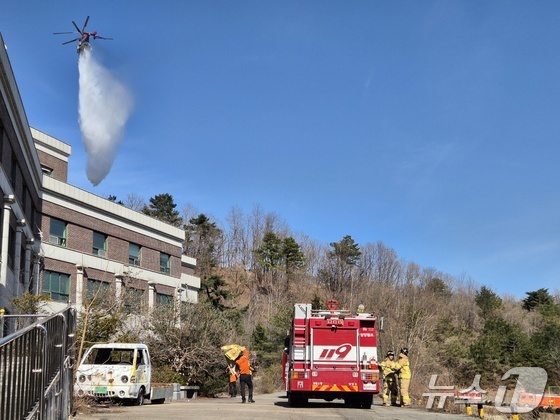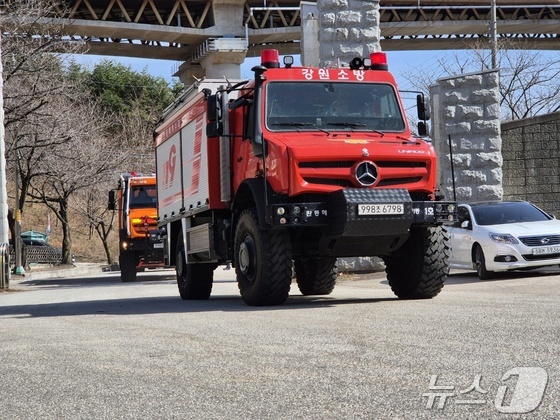
Alert: A simulated wildfire occurred in Donghae City, South Korea, at 1:30 PM (KST). A fire of unknown origin broke out in the mountainous area of 95 San, Iro-dong. The fire spread rapidly, driven by southwestern winds.
On Thursday, urgent radio communications echoed through the fire control room set up on the former campus of Hanzhong University in Gangwon Province, South Korea.
This scenario was part of a training exercise conducted by the Gangwon Fire Department during the spring season to prepare for potential large-scale wildfires along the eastern coast.
Within two minutes of the initial broadcast, sirens blared near the campus as fire engines from Donghae Fire Station’s Buksam 119 Safety Center and Samhwa 119 Safety Center, the closest units to the scene, rushed to the area.
As the simulated fire, driven by southwestern winds, threatened to reach the Donghae City Waterworks Office, the Donghae Fire Department escalated the situation to a Level 1 Response at 1:32 PM (KST), deploying all available personnel in the region.
Upon arrival, fire officials focused on evacuating 20 individuals still in the Hanzhong University dormitory before starting water-spraying operations with fire hoses.
When initial firefighting efforts proved inadequate and the blaze, fueled by strong westerly winds, began to spread toward Donghoedong Village, authorities requested aerial support from firefighting helicopters.
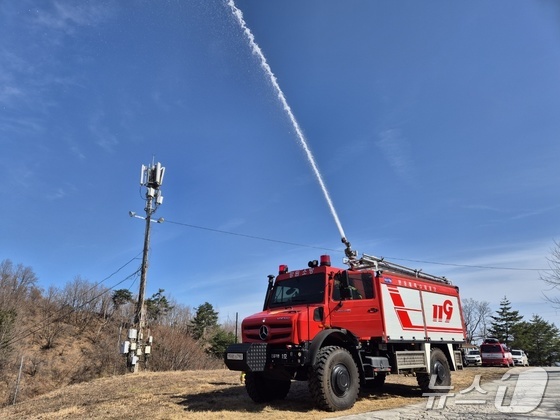
In the simulated scenario, two residents from Donghoedong Village were injured during the evacuation.
As the fire spread to nearby warehouse complexes and the nursing building at Hanzhong University, fire authorities raised the response level to Level 2 at 1:58 PM (KST). This action led to deploying firefighting personnel and equipment from five to six neighboring jurisdictions.
Firefighting helicopters, drawing water from nearby reservoirs, carried out strategic water drops across the fire’s key hotspots.
The high-performance Mercedes Unimog wildfire suppression vehicle, built on the German Mercedes Unimog 5023 chassis, was a notable asset in the firefighting effort. It is widely praised for its ability to maneuver in challenging mountainous terrain.
The Unimog features a massive 4,000-liter water tank—five times larger than a standard wildfire truck, which typically holds 800 liters—and can spray high-pressure water while moving. This capability is particularly beneficial in fighting large wildfires along the eastern coast, where strong winds often limit the effectiveness of helicopters due to weather conditions.
This was underscored during a significant wildfire in the Gyeongpo area last April, when even an 8,000-liter, super-sized firefighting helicopter was grounded. Strong winds reaching 30 meters per second (about 67 miles per hour) prevented the aircraft from starting its engines at the Gangneung Forest Aviation Management Office.
The gale-force winds, strong enough to knock adult off their feet, prevented any aerial response. As a result, the uncontrolled fire quickly spread through Gyeongpo Provincial Park, incinerating vacation homes, residences, and cultural heritage sites in moments.
Given these challenges, on-site personnel concluded that the Mercedes fire truck is far more effective than large firefighting helicopters in fighting wildfires along the eastern coast of South Korea, especially in April, when the notorious local winds called Yangganjipung (a strong spring wind) blow.
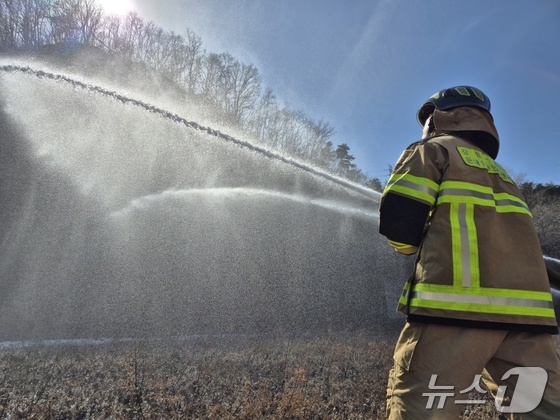
On that day, the Mercedes Unimog fire truck effortlessly navigated the rugged mountainous terrain, releasing 800 liters of water per minute.
The flames began to subside as the Unimog and firefighting helicopters worked together. Soon after, the radio crackled with the announcement: “Main fire extinguished at 2:32 PM (KST).”
Though the exercise was simulated, it resulted in casualties, including one death and two injuries.