

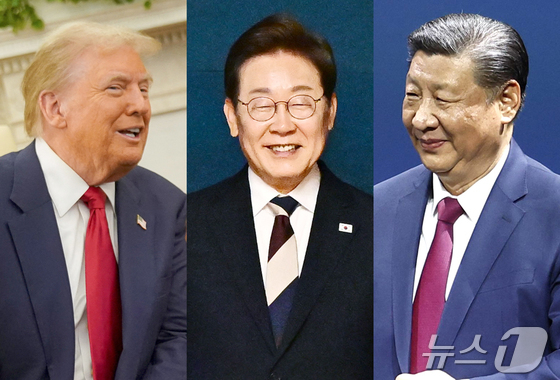
The Asia-Pacific Economic Cooperation (APEC) summit in Gyeongju is just over 10 days away. With U.S. and Chinese leaders expected to visit South Korea, President Lee Jae Myung’s administration now faces a crucial test of its core diplomatic principle: pragmatic diplomacy.
As the summit draws nearer, the ongoing tensions between the two superpowers raise questions about how effectively President Lee’s pragmatic approach can yield results under their pressure.
According to the presidential office and government sources on Monday, key world leaders—including U.S. President Donald Trump and Chinese President Xi Jinping—are set to visit South Korea for the APEC summit beginning on October 31 in Gyeongju.
President Trump is expected to arrive in South Korea on October 29 for a two-day visit, during which he will take part in a U.S.-South Korea summit and a U.S.-China summit. President Xi is also anticipated to visit on October 30.
The APEC summit is poised to trigger a series of high-level meetings: the U.S.-South Korea summit on October 29, followed by the U.S.-China summit on October 30, and then the South Korea-China summit on November 1.
National Security Advisor Wi Sung-lac stated that as is known, President Trump is expected to arrive on October 29 and stay until October 30, during which the U.S.-South Korea summit will likely take place.
The sequence and agenda of these meetings could have a significant impact on the diplomatic balance. If the U.S.-South Korea summit takes place first, it may influence the subsequent U.S.-China talks.
Before the U.S.-China summit, President Trump might urge South Korea to join efforts in countering China, thereby increasing pressure on the South Korean government, which is already working to finalize tariff negotiations.
The escalating U.S.-China trade conflict ahead of the APEC summit adds another layer of complexity. On October 9, China announced export controls on rare earth minerals, prompting the U.S. to threaten a 100% additional tariff on Chinese goods.
South Korea has also felt the repercussions. On October 14, China announced retaliatory measures against five U.S. subsidiaries of Hanwha Ocean, signaling its displeasure with South Korea-U.S. shipbuilding cooperation.
While facilitating negotiations between the two leaders amid U.S.-China tensions may enhance South Korea’s diplomatic standing, leaning too far toward one side could risk destabilizing that delicate balance.
Jeong Jae-hwan, a professor of political science and diplomacy at Inha University, emphasized that it is crucial for the country to uphold the principles of fair trade and adhere to multilateralism, thereby creating an environment that moves away from bilateral negotiations.
With the international spotlight on the summit, the presidential office is making thorough preparations. Advisor Wi stated that they plan to extend the highest level of courtesy to the visiting leaders from the U.S. and China, despite the regional location.
Professor Min Jeong-hoon from the National Diplomatic Academy added that neither the U.S. nor China appears intent on pressuring the other during the summit. This presents an opportunity for South Korea to showcase its pragmatic diplomacy and its role as an international diplomatic hub. Given the fierce competition between the two nations, close attention to protocol coordination is necessary.