

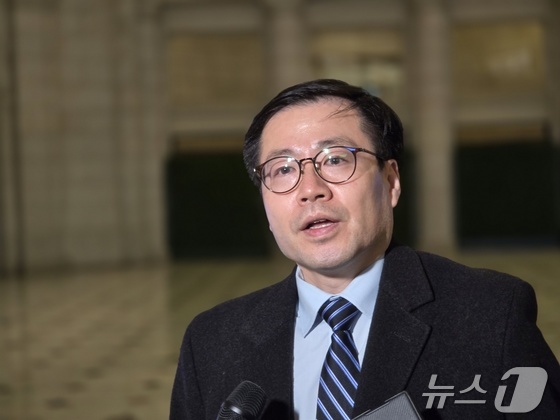
On Wednesday, Yeo Han Koo, the head of the Trade Bureau at the Ministry of Trade, Industry, and Energy, announced that he had postponed his return to South Korea. This decision was made to assess the impact of President Donald Trump’s signing of a proclamation imposing a 25% tariff on artificial intelligence (AI) semiconductor chips from companies like Nvidia.
Yeo met with Korean correspondents at Union Station in Washington, D.C., and discussed the AI semiconductor tariffs imposed under Section 232 of the Trade Expansion Act. He said that following meetings earlier in the day, he became aware of new announcements related to semiconductors and critical minerals. He added that although he had planned to return that evening, he decided to remain in Washington for an additional day to gather more information.
The proclamation signed by President Trump imposes a 25% tariff on imports of certain high-performance computing semiconductors, including Nvidia’s H200 and AMD’s MI325X.
The U.S. administration imposed this tariff as a condition for allowing Nvidia to sell its latest AI semiconductor, the H200, produced through Taiwan’s TSMC, to China.
As a result, chips produced in Taiwan that transit through the U.S. to reach their final destinations, including China, will incur a 25% tariff. Typically, tariffs apply when goods enter the U.S., so H200 chips exported to any country could potentially be affected by the 25% tariff.
On Tuesday, the day before announcing the tariffs, the U.S. Department of Commerce published a notice in the Federal Register, easing the export permit criteria for H200 semiconductors to China.
Consequently, starting at 12:01 AM on Thursday, tariffs will apply to the relevant imported or exported items for consumption.
Yeo cautioned about the impact of the tariffs on the Korean industry, saying it is premature to make definitive statements while the situation is being closely monitored. He added that his team is working with headquarters and industry partners to analyze the potential effects.
Yeo, who arrived in the U.S. on Sunday, had initially planned to travel from Washington, D.C., to New York before returning to Korea on a night flight.
Reflecting on the visit, Yeo noted that it marked the first high-level trip since Korea and the United States agreed to enter tariff negotiations. He said the delegation held extensive meetings across the U.S. government, Congress, and industry, adding that there are very high expectations for Korea’s manufacturing sector and for cooperation on investment.
He added that in relation to the anticipated U.S. Supreme Court rulings on Korea’s digital regulatory legislation and the reciprocal tariffs imposed under the International Emergency Economic Powers Act (IEEPA), the response must be careful and strategic.
Yeo emphasized that this marked the first time a high-ranking Korean government official had come to the United States to explain Korea’s digital legislation to the U.S. Congress and industry. He said he believes this strengthened communication and helped the U.S. side better understand Korea’s position, adding that many expressed appreciation for the explanations provided.
Addressing the Coupang incident and U.S. claims of unfair discrimination against American companies, Yeo clarified that the core issue is a massive data leak that led to personal privacy violations, which he said warrants investigation in both the United States and Korea. He stressed that the matter should not escalate into a trade or diplomatic dispute.