

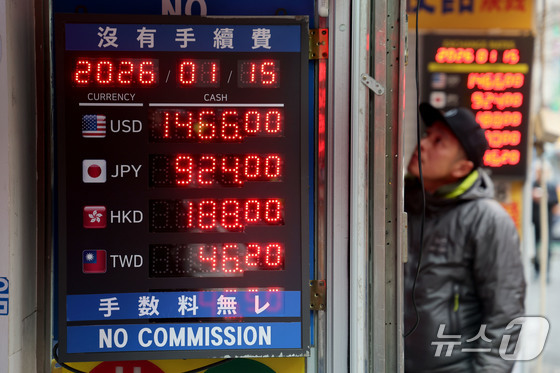
On Friday, Meritz Securities analyzed that currency expansion is not the primary factor behind the weakening of the KRW. Despite increases in the country’s broad money supply (M2), it’s challenging to attribute this solely to government expansionary fiscal policy or budget deficits. Instead, the firm noted that expanded private credit and increased domestic investments abroad have intensified downward pressure on the KRW. Additionally, they assessed that synchronization with the JPY externally and domestic policy uncertainty have further reinforced the upward trend in exchange rates.
Lee Seung-hoon, a researcher at Meritz Securities, argued against pinpointing expansionary fiscal policy or growing budget deficits as the main drivers of M2 growth. He explained that since M2 largely consists of bank deposits (liabilities), the increase in money supply has been more influenced by rising private loans to businesses and households than by government spending. In fact, of the 5.44% domestic credit growth rate last November, government credit contributed only 0.38 percentage points, while private credit had a much larger impact at 3.49 percentage points.
The direction of exchange rates, Lee noted, depends more on capital flows than on the money supply itself. He explained that exchange rates are primarily affected when money not absorbed by the real economy moves into real and financial assets, or when funds are transferred to acquire overseas assets. The exchange rate directly fluctuates as foreigners convert foreign currency into KRW for domestic securities purchases, or as locals exchange KRW for foreign currency to buy overseas securities.
The researcher highlighted a significant shift in the fourth quarter of 2024, when the balance of domestic investments in overseas securities began to exceed foreign investments in domestic securities, a reversal of the historical trend. Lee interpreted this as an indication of increased domestic investor influence on the KRW’s depreciation since that quarter.
This trend has persisted into January this year. Meritz Securities reported that from the beginning of the year until January 12, foreigners net purchased 1.3 billion USD in South Korean bonds, while locals net purchased 2.4 billion USD in overseas stocks.
Policy uncertainty is another factor driving the KRW’s depreciation. Meritz Securities viewed the conclusion of the Korea-U.S. tariff and investment negotiations at the Asia-Pacific Economic Cooperation (APEC) summit in late October as averting a worst-case scenario for foreign exchange market instability. However, growing market skepticism about companies potentially being the main players in securing U.S. investment funds has led firms to delay KRW conversion and maintain foreign currency deposits, possibly restricting dollar supply.
Regarding external factors, synchronization with the JPY was identified as a significant contributor to the KRW’s depreciation in 2025. The researcher noted that the KRW’s depreciation from January to April 2025 showed isolated weakness due to domestic political instability and concerns about deteriorating fundamentals. However, as these concerns eased, synchronization with the JPY intensified in the latter half of the year.
The recent acceleration of the JPY’s depreciation reflects expectations of early elections in February. There are concerns that if Prime Minister Sanae Takaichi wins, strengthened expansionary fiscal policies could undermine fiscal soundness, contributing to the JPY’s weakness.
The researcher predicted that if the Bank of Japan (BOJ) adjusts its economic and price outlook upward in January and takes a strong stance against inflationary pressures, the JPY’s weakness will likely stabilize.