

The expansion of U.S. semiconductor tariffs has emerged as a critical factor for the South Korean economy, which aims to achieve 700 billion USD in exports for the second consecutive year. President Donald Trump signed a proclamation imposing a 25% tariff on specific advanced semiconductors imported into the U.S. and then re-exported to third countries, hinting at more extensive tariffs in the near future.
With semiconductors accounting for roughly 30% of South Korea’s total exports, concerns are mounting that direct tariffs on this sector could have an unavoidable impact on the export-driven economy.
In response to the proclamation, the South Korean government swiftly convened an emergency meeting led by Trade Minister Kim Jeong-kwan to discuss countermeasures. Meanwhile, Trade Negotiations Chief Yeo Han-koo, who was in the U.S. at the time, postponed his return to assess the situation on the ground.
Trump Slaps 25% Tariff on Re-Exported Semiconductors, Threatens Broader Measures
The Ministry of Trade, Industry and Energy reported on Friday that President Trump signed a proclamation on Wednesday imposing a 25% tariff on semiconductors imported into the U.S. and subsequently re-exported to other countries.
This measure is seen as having two primary objectives. First, it allows the export of Nvidia’s artificial intelligence (AI) semiconductor H200 to China while collecting 25% of the sales as a tariff. Simultaneously, it aims to incentivize domestic production by imposing a 25% tariff on high-performance semiconductors produced overseas by companies like Nvidia when imported into the U.S.
While Samsung Electronics and SK Hynix, suppliers of 5th generation High Bandwidth Memory (HBM3E) to Nvidia’s supply chain, aren’t entirely shielded from these measures, industry experts generally believe the short-term impact will be limited as the tariffs don’t apply uniformly to all imported semiconductors.
Yang Joo-young, head of the Economic Security and Trade Strategy Research Office at the Korea Institute for Industrial Economics and Trade, stated that if the measures remain at their current level, the impact on the domestic semiconductor industry should be limited.
The real concern lies in the potential for expanded tariffs. The White House indicated that President Trump may impose broader tariffs on semiconductor and derivative product imports to boost domestic manufacturing and might consider introducing corresponding tariff offset programs.
There are growing concerns that if the scope and level of tariffs expand, it could lead to increased global semiconductor prices and reduced demand.
Semiconductors: A Quarter of South Korea’s Exports… U.S.-Bound Shipments Up 28.4% Despite Tariff Impact
Last year, semiconductors accounted for 24.4% of South Korea’s total exports, effectively driving export performance. While semiconductor exports to the U.S. represent 7.5% of the total (as of 2024), lower than exports to China, Hong Kong, and Taiwan, direct exports to the U.S. are growing rapidly in importance.
According to the Ministry of Trade, Industry and Energy’s ‘2025 Trade Trends’ report, semiconductor exports reached 173.4 billion USD last year, a 22.2% increase from the previous year. Despite a 3.8% decrease in exports to the U.S. due to tariffs, the double-digit growth in semiconductor exports helped offset declines in major items such as automobiles, machinery, and automotive parts.
In fact, exports of key items subject to tariffs, such as automobiles and steel, fell by 13.5% and 17.7% respectively last year. In contrast, semiconductor exports surged by 30%, bolstering overall export performance.
Industry insiders worry that the expansion of U.S. tariffs is not just a bilateral issue but could lead to rising global semiconductor prices and reduced demand.
Given that semiconductors played a crucial role in achieving the historic milestone of 700 billion USD in annual exports last year, experts stress the need for thorough preparations against tariff variables to maintain this record for a second consecutive year.
Government and Industry on High Alert… Trade Chief Responds From U.S. Soil
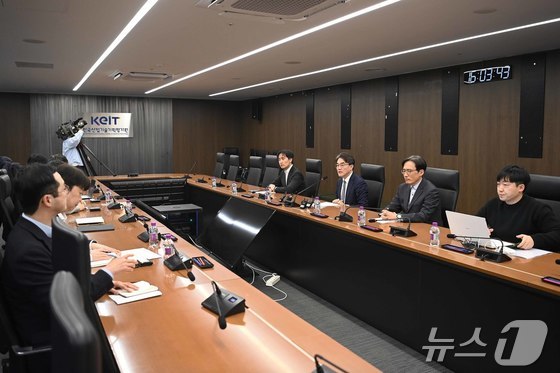
Immediately following the announcement of U.S. tariff measures, the South Korean government and semiconductor industry held emergency meetings to assess the impact and discuss response strategies.
While the immediate effects on the domestic industry are seen as limited, uncertainties remain regarding potential second-phase measures, including tariff levels and offset programs tied to corporate investments.
Trade Minister Kim, who chaired the emergency meeting with industry representatives, emphasized maintaining readiness for various scenarios. This includes considering both the semiconductor tariff measures and the potential final ruling from the U.S. Supreme Court on reciprocal tariff measures. He pledged that it will respond more thoroughly and swiftly to future trade issues with the U.S.
Trade Negotiations Chief Yeo extended his U.S. trip to investigate the situation further.
Speaking to reporters at Washington D.C.’s Union Station, Yeo explained that new administrative orders regarding semiconductors and critical minerals have been announced. He’s decided to stay an extra day in Washington to gather more information, clarifying the reason for his delayed return.