

Samsung Electronics and SK Hynix have found themselves in an unexpected perfect storm since the beginning of the year. Just as they’re poised to ride an unprecedented semiconductor supercycle, the Trump administration has thrown down the gauntlet with a 100% tariff threat, demanding American investment. Meanwhile, on the home front, talks of relocating the Yongin semiconductor industrial complex to Saemangeum have resurfaced.
Industry sources reported on Tuesday that U.S. Commerce Secretary Gina Raimondo recently laid down the law at the groundbreaking for Micron’s new factory in New York, stating that memory chip makers have two choices: pay a 100% tariff or set up shop in the U.S.
The Trump administration’s laser focus on memory semiconductors for local investment is unprecedented. On January 14, the U.S. slapped a 25% tariff on certain cutting-edge semiconductors (H200·MI325X) imported and re-exported to third countries. The very next day, Taiwanese chip firms struck a deal to invest 250 billion USD in new U.S. semiconductor lines in exchange for tariff exemptions.
The long-anticipated semiconductor tariff is now taking shape. South Korea and the U.S. only agreed to a broad most-favored-nation treatment framework last November, ensuring conditions no less favorable than those for competitors like Taiwan. The Trump administration is likely to use the Taiwan agreement as leverage to push for additional semiconductor investments beyond the existing $350 billion commitment.
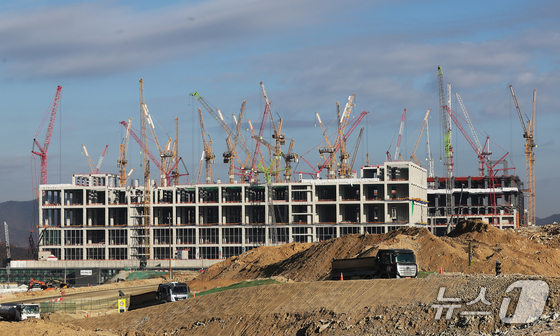
The K-semiconductor industry faces challenges at home as well. Samsung Electronics (national industrial complex) and SK Hynix (general industrial complex) are pouring approximately $270 billion and about $450 billion, respectively, into new fabs or site preparations in the Yongin semiconductor cluster. Now, this massive project has been caught in the crosshairs of a government-initiated Saemangeum relocation debate.
The controversy ignited when Climate, Energy, and Environment Minister Kim Seong Hwan questioned the Yongin location during a CBS interview on December 26. Citing concerns about power shortages in the metropolitan area, he suggested reconsidering whether the project should remain in Yongin or be relocated to a region with more abundant electricity. Many observers view the remarks as political maneuvering ahead of the June local elections.
Industry insiders are sounding the alarm that K-semiconductors may miss their moment. Rosy projections suggest Samsung Electronics and SK Hynix, South Korea’s memory chip titans, could see their combined operating profit soar past about $150 billion this year. This optimism stems from a supply crunch driven by the explosive growth of the artificial intelligence (AI) industry.
A fierce capacity race has erupted as companies scramble to build production facilities and capture market share. In this high-stakes environment, every second counts. Getting bogged down in site re-evaluations could prove disastrous, potentially eroding hard-won competitiveness.
The investment capacity of Samsung Electronics and SK Hynix is already stretched thin, adding another layer of complexity.
Samsung Electronics is currently juggling investment plans totaling nearly $367.5 billion. This includes about $277.5 billion for the Yongin semiconductor cluster, $45 billion for Pyeongtaek’s Plant 5 (P5), and $37 billion USD for its Taylor, Texas facility. SK Hynix isn’t far behind, with plans to invest approximately $450 billion in the Yongin cluster, $14.25 billion in Cheongju’s advanced packaging plant (P&T7), and 3.87 billion USD in West Lafayette, Indiana.
Pivoting ongoing U.S. investments toward memory production lines presents its own challenges. Samsung’s Taylor Plant 1, which is focused on foundry services, is already well into its setup phase. Kim Dong-young, a senior researcher at the Korea Development Institute (KDI), pointed out a critical issue, noting that even if semiconductor fabs are attracted to the U.S., there is a severe shortage of skilled labor, raising doubts about whether actual production would even be feasible.
Industry experts widely regard the proposed relocation of Saemangeum as highly improbable. One of SK Hynix’s four fabs is already well underway and is targeting completion in the first half of next year. Relocating at this stage would effectively mean starting from scratch on fundamental requirements such as securing water supplies for semiconductor processes. An industry insider described the situation as resembling a slow-motion train wreck.