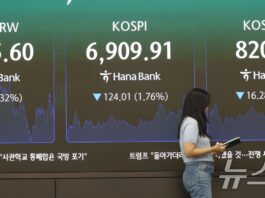
Following President Donald Trump’s warning of a potential 25% tariff hike, South Korea and the U.S. are gearing up for crucial trade talks this weekend. The discussions aim to review the implementation of their existing trade agreement, marking a potential turning point in bilateral relations.
While Trump publicly criticized the South Korean National Assembly for delaying legislation on the Special Law for U.S. Investments, he has not yet taken concrete steps to raise tariffs. This has led many experts to view the situation as a phase of coordination rather than a resurgence of trade conflicts.
To address these concerns, South Korea’s Minister of Trade, Industry, and Energy, Kim Jeong-kwan, will travel to the U.S. on Thursday morning immediately after concluding his visit to Canada. He is scheduled to meet with U.S. Secretary of Commerce Howard Lutnick and engage in substantive trade discussions over the weekend.
During these talks, Minister Kim plans to brief U.S. officials on the progress of the Special Law for U.S. Investments in the South Korean National Assembly and reaffirm Korean companies’ commitment to invest in the U.S.
Limited Ccope for Additional Tariff Negotiations Suggests Smooth Resolution
Trade experts believe that the likelihood of prolonged negotiations is low. Both countries have already reached a broad trade agreement, with the current focus shifting from the content of the deal to its implementation timeline.
Jeong Cheol, director of the Korea Economic Research Institute, told News1 on Thursday that this issue is primarily about coordinating the pace and methods of implementing an already agreed-upon framework, rather than initiating new negotiations. Given the low risk of immediate shock to businesses or industries, it should proceed calmly with diplomatic talks and domestic procedures instead of fueling excessive crisis rhetoric.
Jeong added that once negotiations begin, President Trump’s intentions and demands will become clearer. The measures South Korea needs to take are likely to be straightforward. Unlike the main negotiations, the issues at hand are limited, so it expects these additional tariff talks to be resolved more quickly and smoothly than anticipated.
Some analysts argue that with the U.S. Supreme Court’s ruling on the legality of mutual tariffs postponed until next month, the U.S. might be feeling the time pressure. They suggest that South Korea should leverage this situation strategically to gain an advantage in negotiations.
Song Young-kwan, a senior researcher at the Korea Development Institute, proposed that it should consider the option of passing legislation in the National Assembly after the U.S. court’s ruling.
Song warned that an unfavorable court decision for the U.S. could undermine all major investment commitments made with other countries. He speculated that this might explain Trump’s sudden revival of the tariff issue.
He further noted that the balance of interests between South Korea and the U.S. remains intact. Given that the U.S. also needs allies, it anticipates a compromise based on mutual benefits rather than an emotional standoff.
Regarding claims that discrimination against U.S. platform companies, such as in the Coupang incident, contributed to the tariff threat, experts advise against overinterpretation. They point out that Trump, known for his direct communication style, made no specific mentions of this issue.
Jeong explained that President Trump’s 25% tariff warning should be interpreted, as he stated on social media, as an effort to ensure proper implementation of previously agreed terms between South Korea and the U.S.
He cautioned against speculating on various scenarios, arguing that it could limit South Korea’s diplomatic flexibility.
As trade experts interpret Trump’s remarks as a signal for additional negotiations rather than a termination of talks, recent movements by the U.S. administration seem to support this view.
U.S. Trade Representative Jamieson Greer told Fox Business that he spoke with South Korean officials this morning and will also meet with South Korean trade officials visiting Washington, D.C. this week, indicating the U.S.’s readiness to engage in dialogue.
Key Focus: South Korean Legislative Schedule and Investment Roadmap
The success of these additional tariff discussions will likely hinge on the South Korean National Assembly’s legislative timeline and the presentation of a clear roadmap for investment implementation.
To this end, Minister Kim will arrive in the U.S. on Thursday at 11:25 a.m. (Korean time) for an urgent meeting with U.S. Secretary of Commerce Lutnick, immediately following his Canadian visit.
During this meeting, Minister Kim aims to clarify the solution mentioned by President Trump while updating U.S. officials on the status of the Special Law for U.S. Investments in the South Korean National Assembly and reaffirming Korean companies’ investment commitments.
Yeo Han-koo, head of the Trade Negotiation Headquarters, is also planning to depart around Thursday. He is set to meet with United States Trade Representative (USTR) representative Greer to engage in detailed negotiations aimed at finding a mutually acceptable solution.
A South Korean government official stated that the overall framework of the trade agreement remains unchanged, adding that it believes that any misunderstandings can be readily resolved during the ministerial-level talks.
On Tuesday, the White House officially stated that President Trump’s intention to raise mutual tariffs on major items, including South Korean cars, back to 25% was due to South Korea’s failure to fulfill promises made in exchange for tariff reductions.
The U.S. had previously agreed to reduce mutual tariffs on South Korean cars from 25% to 15% in exchange for South Korea’s commitment to invest 350 billion USD in the U.S. over three years.
The U.S. administration’s primary concern is the speed of investment implementation. Although the Special Law for U.S. Investments was proposed following the leaders’ agreement last November, it has yet to pass through the South Korean National Assembly. The U.S. argues that despite retroactively applying tariff reductions, there has been no progress in fulfilling the promises due to South Korea’s delay in finalizing the legislation.