

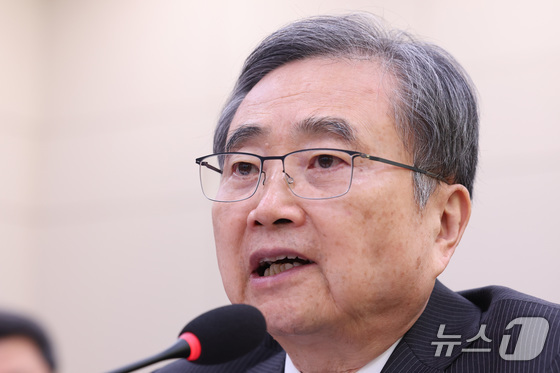
Foreign Minister Cho Hyun announced on Wednesday that President Donald Trump’s declaration to raise mutual tariffs on South Korea is not directly related to the Coupang incident or the introduction of the online platform bill.
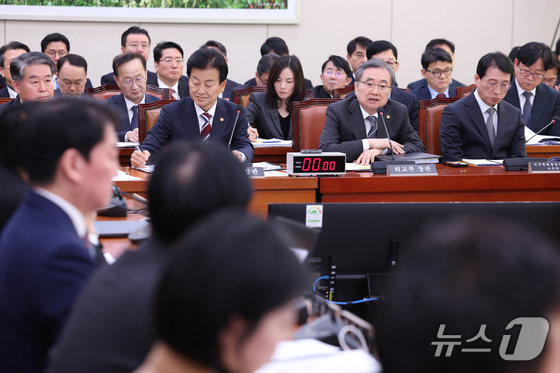
Minister Cho explained this during a Q&A session at the National Assembly’s Foreign Affairs and Unification Committee. He stated that, following President Trump’s message, based on contact with the U.S. State Department, the government had concluded that the issue was not directly related to Coupang or the online platform law.
He also clarified that it was certainly not due to the lack of parliamentary ratification of the Korea–U.S. Joint Fact Sheet, while noting that pinpointing a specific and reasonable cause was difficult.
Regarding President Trump’s remarks about working smoothly with the Korean government on the matter, Cho said the government would handle the issue appropriately with the United States in line with its fundamental position.
On Monday, President Trump announced on his social media platform, Truth Social, that he would raise mutual tariffs from 15% to 25%, citing the Korean legislature’s failure to enact the historic trade agreement.
The enactment Trump referred to likely means the “Special Act on Korea-U.S. Strategic Investment Management.”
Last November, Korea and the U.S. signed a memorandum of understanding (MOU) based on their trade agreement. They agreed to retroactively apply tariff reductions from the first day of the month in which the bill to implement the MOU was submitted to the Korean National Assembly.
The ruling Democratic Party of Korea introduced the Special Act on Korea-U.S. Strategic Investment Management to the National Assembly on November 26. Subsequently, on December 4, the U.S. reduced tariffs on Korean automobiles to 15%. The Special Act is currently pending in the National Assembly.
Minister Cho emphasized that the MOU is not a treaty and lacks legal binding force, noting that the United States had also not gone through congressional procedures. He stressed that at this point it was crucial to obtain parliamentary consent and follow the necessary procedures for matters that could burden the public through a Special Act.
Regarding U.S. Chargé d’Affaires James Heller’s letter on the 13th to Deputy Prime Minister and Minister of Science and ICT Bae Kyung Hoon, urging the implementation of the digital and trade agreement from the Korea-U.S. Joint Fact Sheet, Cho said that the relevant details had been reported to the Presidential Office and the Prime Minister’s Office on January 14.
This indicates that Prime Minister Kim Min Seok was aware of the situation before his U.S. visit (January 22 to 26), where he met with U.S. Vice President J.D. Vance. It appears that Prime Minister Kim and Vice President JD Vance focused more on addressing misunderstandings about issues such as the Coupang incident than on engaging in detailed discussions on the matter.