

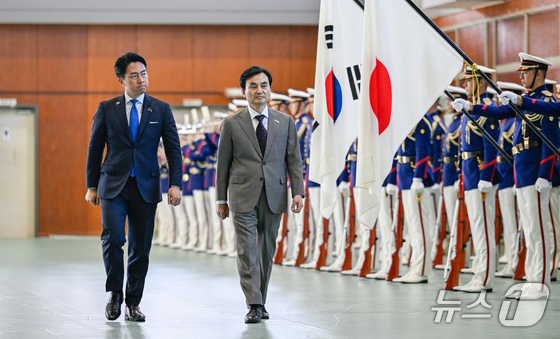
On Friday, South Korean Defense Minister Ahn Kyu Baek and Japanese Defense Minister Shinjiro Koizumi met at the Yokosuka Naval Base in Kanagawa Prefecture, Japan.
Japanese media outlets reported that both nations agreed to bolster U.S. deterrence capabilities in the region. The Nikkei emphasized that the two ministers acknowledged the critical need for cooperation in addressing escalating regional threats, including North Korea’s nuclear and missile activities and China’s military expansion.
In a significant move towards practical military collaboration, they agreed to resume joint maritime search-and-rescue exercises for humanitarian purposes after a nine-year hiatus.
Analysts view this meeting as a crucial turning point, signaling a swift resolution to tensions between South Korean and Japanese military authorities that erupted last November and a shift towards a cooperative relationship.
The previous rift occurred when Japan refused to provide refueling support for South Korea’s Air Force aerobatic team, the Black Eagles, during a training exercise near Dokdo, prompting South Korea to suspend joint drills in retaliation.
However, the atmosphere improved following a summit between the two countries’ leaders on January 13. The conflict was further eased when refueling for the Black Eagles actually took place on Wednesday, just prior to the defense ministers’ meeting.
Minister Ahn reportedly emphasized during the talks that resolving recent challenges through open communication between the two countries has benefited cooperation.
The Nikkei also noted the symbolic significance of choosing Yokosuka as the meeting location. Yokosuka is a strategic hub, home to the Japan Maritime Self-Defense Force’s escort fleet and submarine command, as well as the U.S. Navy’s 7th Fleet headquarters and a homeport for nuclear aircraft carriers.
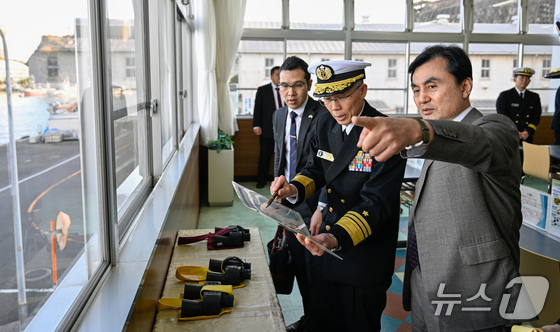
By meeting at the heart of the U.S.-Japan alliance, the South Korean and Japanese defense ministers underscored their commitment to cooperation. This mirrors former Japanese Defense Minister Nobuo Kishi’s visit to Pyeongtaek last September.
Both Yokosuka and Pyeongtaek serve as crucial naval and U.S. military facilities that counter North Korean and Chinese threats. The ministers’ choice to hold meetings at these locations clearly demonstrates their strategic intent to jointly address regional threats with U.S. military backing.
South Korea and Japan appear to be developing a strategy that maintains the U.S. as their primary security partner while also addressing areas where they cannot rely solely on U.S. support, relying instead on their own efforts and mutual cooperation.
However, the Asahi Shimbun reported that the two ministers did not reach a consensus on all issues.
While Japan is considering signing an Acquisition and Cross-Servicing Agreement (ACSA) with South Korea to facilitate mutual support for military supplies during peacetime or emergencies, South Korea is reportedly taking a cautious approach, mindful of its relations with China and North Korea.