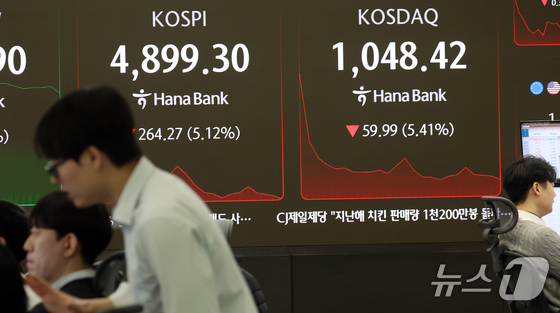
On Friday, the Korean stock market tumble sent shockwaves through South Korean exchanges. The KOSPI index briefly dipped below 4,900, while the KOSDAQ retreated to around 1,040.
At 9:33 a.m. in Seoul, the KOSPI was at 4,957.02, down 206.55 points, or 4.00%, from the previous close.
Early in the session, a sell-side circuit breaker was triggered for the first time in four trading days, causing the index to plummet to 4,899.30, its lowest intraday level since January 21 (4,807.13).
Individual investors scooped up a net 738.6 billion KRW (approximately 553.95 million USD) worth of shares. In comparison, institutions and foreign investors offloaded 153.7 billion KRW (about 115.28 million USD) and 584.9 billion KRW (about 438.68 million USD), respectively, pushing the index lower.
Among the KOSPI’s top 10 companies by market cap, Hanwha Aerospace nosedived 7.01%, SK Square tumbled 6.84%, Hyundai Motor slid 5.73%, SK Hynix fell 4.28%, Doosan Enerbility dropped 3.97%, Samsung Electronics Preferred declined 3.88%, Samsung Electronics shed 3.52%, LG Energy Solution lost 3.29%, Kia dipped 3.27%, and Samsung Biologics retreated 2.71%.
Samsung Electronics’ stock price hit a low of 151,000 KRW (approximately 113.25 USD) during trading, while SK Hynix broke its 800,000 Hynix streak after eight sessions.
On Thursday, Wall Street took a hit as concerns mounted over AI companies’ hefty capital expenditures (CAPEX), coupled with deteriorating job market conditions and a sharp drop in precious metal prices. The Dow Jones Industrial Average fell 1.20%, while the Nasdaq and S&P 500 both declined 1.23%.
Major tech giants with substantial cloud operations, known as hyperscalers, confirmed plans to ramp up CAPEX, triggering a sell-off in AI-related stocks. While increased CAPEX was previously seen as a boon for the AI value chain, investors now question whether these investments will yield adequate returns.
As a result, Alphabet, Google’s parent company, slipped 0.6%, while Microsoft and Amazon plunged 4.95% and 4.42%, respectively. Even Nvidia, despite expectations of increased AI investment, fell 1.33%.
Weakening employment data further dampened investor sentiment. Challenger, Gray & Christmas reported that U.S. companies planned 108,435 layoffs in January, the highest since January 2009, in the aftermath of the financial crisis. Adding to the market woes, gold and silver prices plummeted by over 3% and 16%, respectively, due to margin-related issues.
Han Ji Young, an analyst at Kiwoom Securities, said foreign investors’ net selling appeared to be largely driven by profit-taking. However, she added that in the short term, investors needed to stay vigilant about continued foreign selling and focus on managing portfolio returns.
The KOSDAQ index fell 40.46 points (3.65%) to 1,067.95, touching a low of 1,048.28 during the session. Institutions and foreign investors were net buyers, purchasing 79 billion KRW (approximately 59.25 million USD) and 157 billion KRW (about 117.75 million USD) worth of shares, respectively. In comparison, individual investors sold a net 213.6 billion KRW (about 160.2 million USD).
Among the KOSDAQ’s top 10 companies by market cap, Samchundang Pharmaceutical bucked the trend, rising 0.4%.
However, Rainbow Robotics plummeted 8.02%, Kolon TissueGene slumped 7.11%, EcoPro BM fell 5.2%, Rigakem Bio dropped 5.11%, ABL Bio declined 4.62%, Alteogen shed 4.52%, EcoPro lost 3.76%, HLB dipped 3.06%, and Rino Industrial retreated 2.72%.