

President Donald Trump’s latest tariff threat has put Hyundai Motor Company in the crosshairs, potentially exposing the automaker to as much as $7.5 billion in added costs. Coming just after Hyundai posted a record U.S. sales result in January, the prospect of higher tariffs is an especially sharp blow.
Unlike last year, if a 25% tariff is applied from the beginning of this year, the damage will inevitably be more severe. If the tariff risk persists, Hyundai may have to revise its business plans for the year.
According to industry sources on Thursday, the Trump administration is preparing to publish a notice detailing plans to raise tariffs on South Korean imports from 15% to 25%.
On January 26, President Donald Trump announced on social media that he would increase tariffs on South Korean automobiles, lumber, pharmaceuticals, and other goods from 15% to 25%, citing the South Korean National Assembly’s failure to ratify a trade agreement.
The South Korean government has dispatched high-ranking officials, including Minister of Trade, Industry and Energy Kim Jeong Kwan, Foreign Minister Cho Hyun, and Trade Minister Yeo Han Koo, to the United States for negotiations. However, no significant progress has been confirmed.
Instead, it’s reported that the U.S. has begun the process of officially announcing the tariff increase through a government gazette.
Given that President Trump specifically mentioned National Assembly ratification, the South Korean government’s strategy is to find a breakthrough by expediting the processing of a special law on U.S. investment.
The National Assembly has agreed to form a special committee to handle the special law and is accelerating discussions on it. The special law could potentially be processed as early as February 9.
However, it remains uncertain whether the U.S. will withdraw the tariff increase even after the special law is passed. Trade Minister Yeo, who returned from the U.S. early this morning, stated that while the National Assembly’s move to expedite legislation is certainly helpful, it’s impossible to predict whether the U.S. will retract the tariff hike after the special law is passed.
As U.S.-Korea negotiations show no clear progress, tension in the automotive industry is mounting. There are concerns that the scale of tariff damage could surpass last year’s figures.
Last year, Hyundai Motor Company bore approximately $3.08 billion in tariff costs, while Kia faced $2.32 billion. The combined tariff burden for both companies exceeds $5.4 billion. This was due to the 25% tariff rate applied from April and the 15% rate from November last year.
If the 25% tariff is reapplied, the burden is expected to increase further. Hana Securities estimates that Hyundai and Kia’s tariff burden could reach $8.1 billion due to the tariff hike.
Meritz Securities analyzes that if tariffs increase, Hyundai will incur an additional $2.33 billion nd Kia $1.65 billion in operating costs. They estimate this could lead to a 23% reduction in Hyundai’s annual operating profit consensus and a 21% reduction for Kia.
Given the expected monthly tariff burden of hundreds of billions of won, there are calls to delay the implementation of the tariff increase as much as possible. Trade Minister Yeo’s emphasis on whether the increase will be immediate or have a 1-2 month grace period, even if published in the U.S. gazette, aligns with this perspective.
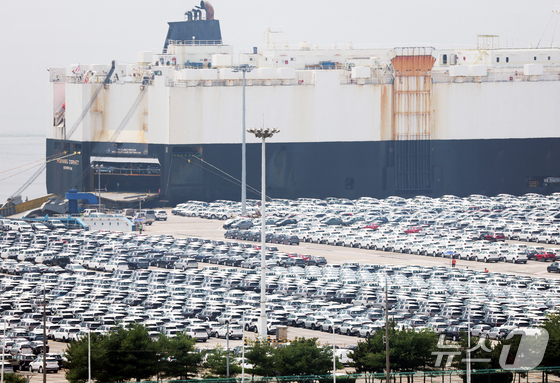
There are concerns that if Japanese and European Union competitors continue to face a 15% tariff while Korean companies face a 25% tariff, this could weaken competitiveness in the U.S. market. This could potentially derail the recent positive sales momentum.
Last year, Hyundai surpassed 1 million annual wholesale units in the U.S. for the first time in its history. Last month, Hyundai and Kia sold 125,296 units in the U.S. market, a 7.7% increase from the same month last year, setting a January sales record.
If the tariff burden persists, companies may have to raise prices or reduce incentives for sales expansion. An industry insider said the U.S. market is crucial to global performance and added that if tariffs increase, companies could face tough choices between maintaining price competitiveness and defending sales volumes.
The expanding tariff burden is likely to impact business strategies as well. The industry had set this year’s business plans assuming tariff costs similar to last year, considering the tariff application period.
Efforts to expand U.S. investments in response to tariff risks are also accelerating. José Muñoz, president of Hyundai Motor, said in a Wall Street Journal interview published on Saturday that the company was focusing on accelerating U.S. investment, adding that the sooner it could reap the benefits, the better.