

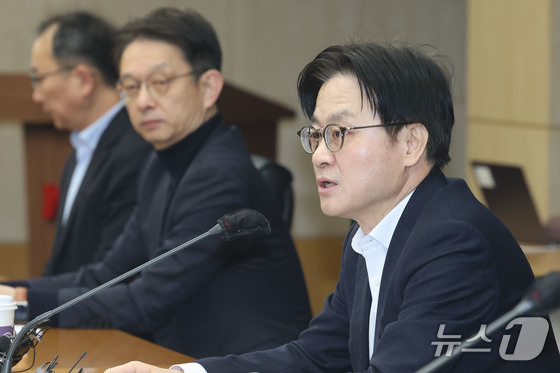
On Monday, Minister of Trade, Industry, and Energy Kim Jung-kwan announced the activation of a contingency plan in anticipation of the U.S. Supreme Court’s ruling on the legality of reciprocal tariff measures imposed by President Donald Trump.
During a press briefing at the Government Complex in Sejong, Minister Kim addressed recent U.S. discussions about reimposing tariffs and provided updates on the renewed tariff negotiations.
He stated that it is preparing for various scenarios, including total unconstitutionality, partial unconstitutionality, and constitutionality, while asking for understanding that he could not disclose specific details.
The Trump administration is currently awaiting the Supreme Court’s final decision on the legality of reciprocal tariffs imposed under the International Emergency Economic Powers Act (IEEPA). This law has been used as leverage in trade negotiations with South Korea, Japan, the European Union (EU), and others.
Analysts suggest that President Trump’s threat to raise tariffs on South Korean automobiles to 25%, citing delays in South Korea’s legislative action, is a strategic move. It aims to create favorable conditions ahead of the anticipated Supreme Court ruling, expected around February 23.
Coupang Issue Separate From U.S. Investment Delays, Not Due to Korean Negligence
Minister Kim clarified that the renewed tariff threats should not be associated with the so-called Coupang incident.
He explained that it views U.S. investment issues and non-tariff barriers related to Coupang as separate matters. President Trump’s social media comments primarily concern delays in special legislation, and he seems to be raising multiple issues comprehensively.
Minister Kim also shared insights from his recent discussions with U.S. Secretary of Commerce Gina Raimondo. He noted that Secretary Raimondo had some misunderstandings. She expected that signing the strategic investment memorandum of understanding (MOU) in November would lead to immediate action in December. Minister Kim explained that the National Assembly’s budget review and hearing schedules realistically prevented such quick progress.
He added that Secretary Raimondo wasn’t aware of the difference between Japan and Korea, where investments often require legislation. Minister Kim clarified that Korea hasn’t been negligent. He also informed her about the bipartisan agreement to process the special legislation by March.
Regarding the first U.S. strategic investment project, he stated that they’re discussing several proposals, and cautioned against speculation, adding that they’re not focusing on any specific project at this time.
When asked about the timing of the long-delayed Korea-U.S. Free Trade Agreement (FTA) Joint Committee meeting, he replied that it should be held within a reasonable timeframe.
Responding to Foreign Minister Park Jin’s recent suggestion of transferring trade duties to the Ministry of Foreign Affairs, he carefully stated that right now, it needs to focus on solving problems with a united front.
Fake News Dispute Surrounds Korea Chamber… Public Bodies Should Be Cautious in Judging Facts
He expressed that initially, reports about wealthy individuals leaving due to inheritance tax made him realize the seriousness of Korea’s inheritance tax issue. However, he was surprised to learn of problems with the data.
He noted that he assumed the Korea Chamber of Commerce & Industry (KCCI) was a credible source, but the data came from an immigration consulting firm and didn’t even mention inheritance tax.
That morning, the Ministry of Industry held an emergency meeting in Seoul, announcing an audit of the press release process and potential legal action if necessary.
Minister Kim clarified that this audit is about oversight of relevant institutions, not a response to fake news.
He emphasized that it expects KCCI’s releases to be thoroughly vetted. When they’re not, it becomes problematic. He’s urged for systems to prevent incorrect data citations. He added that this reminds us that all public institutions, including the ministry, must be vigilant about spreading misinformation.
He continued that he hopes this incident leads economic organizations to become more trustworthy and authoritative. It doesn’t want this controversy to discourage input to the government, and it’ll work to ensure it doesn’t.
The Ministry of Industry promptly launched an audit into the circumstances surrounding the KCCI’s press release and its factual basis.
The controversy stemmed from KCCI’s February 3 press release titled, Analysis of Inheritance Tax Revenue Projections and Effects of Diversifying Payment Methods. Citing research from UK-based Henley & Partners, it claimed that 2,400 high-net-worth individuals left Korea last year, double the previous year and the fourth highest globally. Critics quickly pointed out the study’s unclear methodology and criteria.
President Lee Jae Myung emphasized on X (formerly Twitter) that deliberate misinformation that clouds the judgment of policy-making citizens is an enemy of democracy, stressing the need for accountability and preventive measures.