

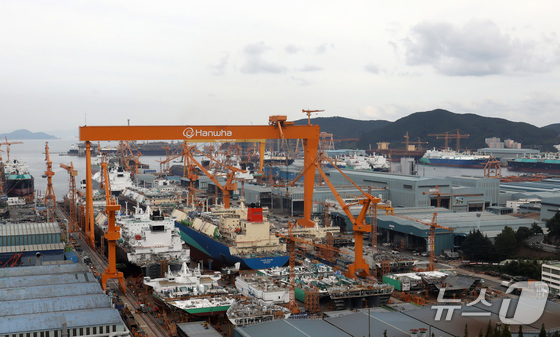
The Make American Shipbuilding Great Again (MASGA) project, proposed by South Korea to President Donald Trump to revitalize the U.S. shipbuilding industry, has come under scrutiny from international media for its reliance on low-wage migrant workers and high accident rates.
In a Thursday article titled, The Shipbuilding Industry Trump Envies, But South Koreans Shun, Bloomberg reported that South Korea’s shipbuilding sector is one of the country’s most hazardous industries, claiming dozens of lives annually.
While South Korean shipyards may appear efficient and cost-effective on the surface, Bloomberg revealed a more complex reality beneath the facade. A significant number of low-wage migrant workers are exposed to high-risk tasks.
The International Labour Organization (ILO) reports that South Korea’s industrial accident fatality rate is approximately 4 per 100,000 workers, exceeding the Organisation for Economic Co-operation and Development (OECD) average of about 3. In 2024, the shipbuilding industry’s death rate was more than quadruple the national average.
This has led to an exodus of skilled Korean workers from the shipbuilding sector, with companies filling the void with migrant workers to reduce costs. Bloomberg noted that the shipbuilding industry has one of the highest concentrations of migrant workers across all sectors in South Korea.
As of April last year, over 23,000 migrant workers held employment visas in domestic shipyards. The proportion of subcontracted and temporary workers in shipbuilding is around 63%, far surpassing the 16% industrial average. Many of these workers are migrants assigned to dangerous tasks, heightening their risk of accidents.
Experts caution that exporting this heavy reliance on migrant labor to the U.S. could lead to significant issues.
Kim Hyun-joo, director of the Ulsan Migrant Center, told Bloomberg that the most alarming aspect is that they’re exporting a shipbuilding model that barely functions domestically. If this industry heavily depends on a severely restricted foreign workforce, it’s questionable whether this model can be successfully implemented in the U.S., where regulations and oversight are far more stringent.
During last year’s tariff negotiations, South Korea committed to 350 billion USD in U.S. investments, with 150 billion USD allocated to the MASGA project. However, on January 26, President Trump threatened to increase tariffs on South Korea from 15% to 25%, citing slow progress in fulfilling these investment pledges.
Bloomberg expressed concern that amid ongoing uncertainty surrounding the trade agreement, the shipbuilding sector – one of the most notable achievements – has become a target for intense scrutiny. Failure to meet these commitments could potentially derail the entire agreement.