The U.S. Supreme Court’s ruling declaring Donald Trump’s tariffs illegal triggered a widespread rally in both U.S. and European stock markets over the weekend.
This development is likely to fuel a similar rally in Asian markets opening on Monday, with the KOSPI poised to make a run at the 6,000 mark.
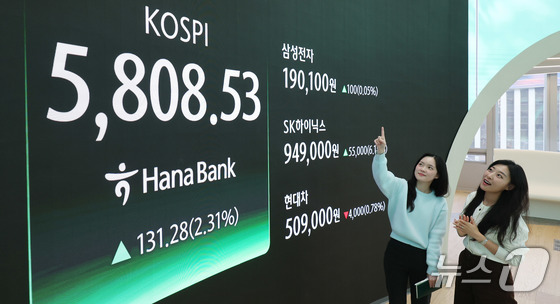
The KOSPI closed at a robust 5,808.53 points last weekend, surpassing the 5,800 threshold and raising expectations for a breakthrough above 6,000 to unprecedented levels.
In response to the Supreme Court’s ruling on February 20 that deemed his tariffs illegal, Trump swiftly invoked Section 122 of the Trade Act, imposing a blanket 15% tariff worldwide.
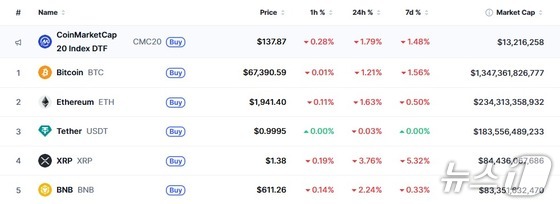
This move has stoked fears of heightened tariff uncertainty, causing a ripple effect in the cryptocurrency market. At present, Bitcoin has dipped 1.21% while Ripple has fallen 3.76%.
Despite these short-term fluctuations, market experts are unanimous in their belief that the Supreme Court’s decision significantly curtails Trump’s tariff-imposing powers, setting the stage for a potential long-term rally in global stock markets.
While Trump has leveraged Section 122 to implement a 15% global tariff, this measure comes with inherent limitations.
Section 122 empowers the president to act unilaterally in cases of severe balance of payments deficits. However, it caps the tariff rate at 15% and restricts the duration to a maximum of 150 days.
Any extension beyond this period requires congressional approval. Given the current political landscape, where Republicans hold only a slim majority in Congress and face opposition from Democrats and even some within their own ranks regarding Trump’s trade policies, securing such approval seems unlikely.
Trump’s next strategic move may involve Section 301 of the Trade Act. This provision authorizes the president to impose tariffs and import restrictions as retaliatory measures following an investigation by the U.S. Trade Representative (USTR) into unfair foreign trade practices.
Sections 301 through 309, strengthened in the comprehensive Trade Act of 1988, are collectively known as Super 301. This provision has long been the U.S. government’s ace in the hole during trade disputes.
Trump appears to be plotting a two-pronged approach: first, enacting the 15% global tariff under Section 122, then fully activating Section 301 to impose long-term tariffs.
However, time presents a significant hurdle. Super 301 mandates consultations with affected countries, publication in the Federal Register, and public hearings. Any procedural missteps could lead to defeat in subsequent litigation.
Historical precedent shows that past Super 301 investigations targeting China and the European Union took six months to a year before actual tariffs were imposed.
The current situation is even more complex, as it involves addressing multiple major countries simultaneously. Given the U.S. Trade Representative’s (USTR) limited personnel resources, finalizing substantial actions within the 150-day window seems practically impossible.
Consequently, Trump’s tariff authority faces significant constraints. In the long run, the Supreme Court’s ruling is expected to act as a catalyst for global stock markets.
The positive sentiment was already evident over the weekend, with U.S. markets seeing gains across the board: the Dow rose 0.47%, the S&P 500 climbed 0.69%, and the Nasdaq advanced 0.90%.
European markets echoed this optimism, with Germany’s DAX up 0.87%, the UK’s FTSE rising 0.56%, and France’s CAC gaining 1.39%. As a result, the pan-European Stoxx 600 index closed up 0.84%.
The Korean stock market is also expected to ride this wave of positivity, increasing the likelihood of the KOSPI breaking through the 6,000 barrier.