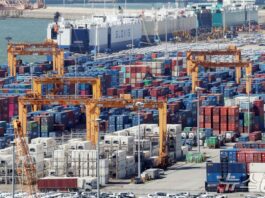
The Trump administration has launched an investigation under Section 301 of the Trade Act to impose retaliatory tariffs in response to the recent ruling on mutual tariffs. This move has thrust South Korea’s digital policies into the spotlight of U.S.-Korea trade negotiations.
The U.S. government’s pressure encompasses several ongoing issues, including pending legislation to regulate online platforms in Congress and the repeatedly delayed export of high-precision maps. As the U.S. ramps up pressure on South Korea’s digital policies, the future of these policies faces growing uncertainty.
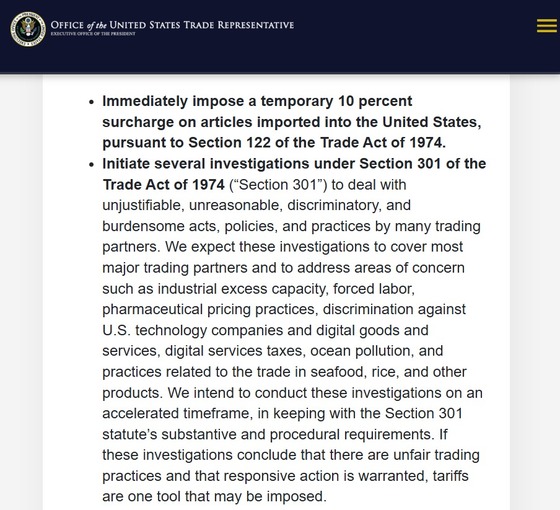
Industry sources revealed on Monday that U.S. Trade Representative Jamieson Greer announced on Friday the initiation of an investigation into unreasonable and discriminatory practices of major trading partners under Section 301 of the Trade Act.
Section 301, enacted in 1974, allows the U.S. to impose tariffs on foreign governments that implement unreasonable or discriminatory measures against U.S. companies. The USTR explicitly stated that digital regulations affecting U.S. interests could be subject to these tariffs.
Greer explained that the investigation is expected to address concerns such as discrimination against U.S. tech firms and digital goods and services, as well as digital services taxes. He added that if unfair trade practices are found and deemed to require action, tariffs may be imposed.
This move serves as a pressure tactic following President Trump’s announcement to raise global tariffs to 15% under Section 122 of the Trade Act, in response to the Supreme Court’s ruling. The Court had previously declared the mutual tariffs imposed by the Trump administration under the International Emergency Economic Powers Act (IEEPA) illegal, effectively nullifying the tariffs imposed on countries, including South Korea.
As the investigation intensifies, the U.S. government may escalate its pressure on South Korea’s digital regulations. The U.S. has long viewed South Korea’s policies on network usage fees, online platform regulation, and restrictions on high-precision map exports as discriminatory against U.S. companies, and has linked these issues to trade negotiations.
Last month, the U.S. Embassy in South Korea sent a letter to the Deputy Prime Minister and Minister of Science and ICT, urging compliance with the U.S.-Korea Joint Fact Sheet. While specific details were not disclosed, the main message was to avoid discrimination against U.S. companies in digital policy.
The pending decision on Google and Apple’s requests to export high-precision maps, which have been repeatedly postponed, is now under scrutiny amid U.S. pressure. Google recently submitted revised documents to the Ministry of Land, Infrastructure and Transport, addressing some government concerns, while Apple’s decision deadline has been extended to this year, contingent on further documentation.
The debate over network usage fees, which Korean telecom companies want to impose on major traffic generators like Google and Netflix, seemed to have reached a resolution with Netflix and SK Broadband’s 2023 strategic alliance. However, the current administration has reignited discussions on legalizing these fees. Congress is now considering amendments to the Telecommunications Business Act, dubbed the “Anti-Free-Riding Law.”
Several bills related to online platform regulation, collectively known as the “Online Platform Act,” are pending in Congress. These fall into two main categories: antitrust legislation to regulate market dominance abuse, and fair trade laws to prevent unfair practices between platforms and vendors. The U.S. has consistently expressed concerns about the antitrust provisions, fearing they could target American tech giants like Google, Apple, and Meta.
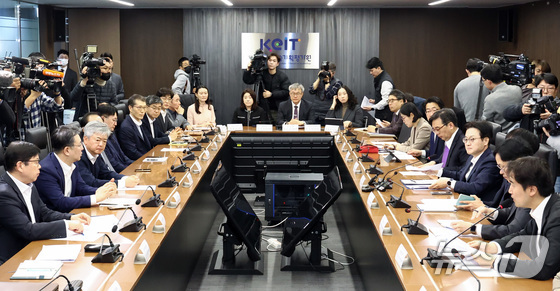
While the U.S. ruling on mutual tariffs appears favorable to South Korea by suspending existing tariffs, analysts suggest that the Section 301 investigation has actually increased uncertainty in the trade environment.
Experts argue that despite intensified U.S. pressure on digital regulations, the South Korean government should strategically leverage its strengths in other industries to find common ground with the U.S. in the digital sector.
An An Jeong-sang, an adjunct professor at Chung-Ang University and vice-chairman of the Democratic Party’s special committee on information and communication, said the Trump administration’s tariff policies lack consistent criteria, creating significant uncertainty. He added that South Korea should strategically negotiate in the digital sector by leveraging competitive assets such as semiconductors.
Huh Yoon, a professor at Sogang University’s Graduate School of International Studies, said the U.S. government has long voiced complaints about South Korea’s non-tariff barriers, and warned that the current situation, with expectations of digital regulation tariffs, could work against Seoul. He added that South Korea needs to clearly define what it can concede to the U.S. and what it must protect, to set a clear direction for its digital policies.