

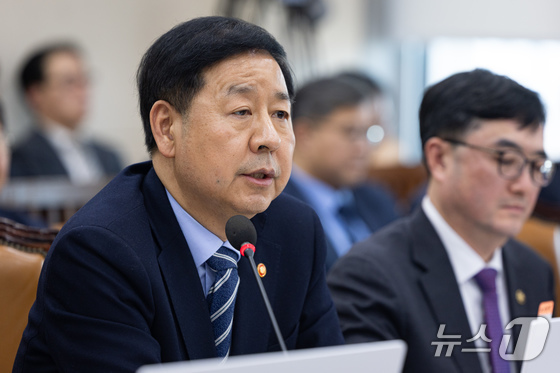
South Korea’s Deputy Prime Minister and Finance Minister Koo Yun Cheol addressed the anticipated introduction of a 15% global tariff by the United States, following the U.S. Supreme Court’s ruling invalidating reciprocal tariffs. He emphasized that the situation’s uncertainty could lead to either positive or negative outcomes, stressing the importance of faithfully implementing existing agreements with the U.S.
Koo made these remarks during a National Assembly Finance and Economy Committee session on Monday, responding to questions from lawmakers Park Dae Chul and Park Hong Geun regarding U.S. tariff issues.
After the U.S. Supreme Court invalidated reciprocal tariffs under the International Emergency Economic Powers Act (IEEPA), President Donald Trump announced plans to impose a 15% global tariff on all countries, replacing the legal basis with Section 122 of the Trade Act. Items covered by Section 232 of the Trade Expansion Act, such as steel and automobiles, will be exempt. The measure is set to take effect at 2 PM Korean time on Tuesday.
When asked about the potential impact on South Korea’s economy, Koo acknowledged the high level of uncertainty, stating that there could be both positive and negative aspects. He assured that the government would respond proactively to any changes in the situation.
Regarding the government’s response strategy, Koo emphasized that faithfully implementing existing agreements would likely be viewed positively by the U.S. He also stressed the urgent need to pass the special law on U.S. investments.
Addressing concerns about potential delays in passing the special law, Koo warned that failure to implement the Memorandum of Understanding (MOU) could be misinterpreted by the U.S., with negative consequences.
Koo expressed gratitude towards opposition members for recognizing the national importance of the issue and agreeing to expedite the bill’s processing. He noted that the U.S. is closely monitoring the progress of this procedure.
On the possibility of Korean exporters participating in refund lawsuits related to the invalidated reciprocal tariffs, Koo adopted a cautious stance. He explained that for refunds to occur, U.S. importers must initiate the process, emphasizing the need to consider the contractual relationships between Korean exporters and U.S. importers.