

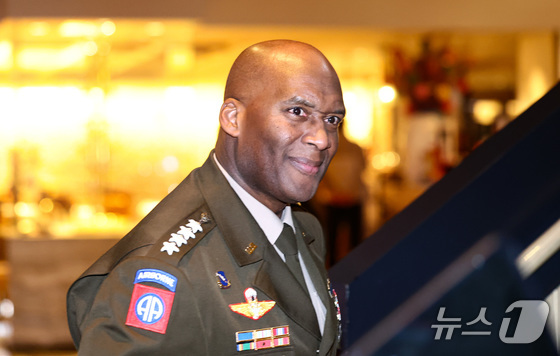
The U.S. Forces Korea (USFK) has firmly refuted recent reports claiming that Gen. Xavier Brunson, Commander of USFK and Republic of Korea (ROK)-U.S. Combined Forces Command, apologized to South Korean military officials regarding an incident where U.S. fighter jets encountered Chinese aircraft during a solo training mission over the Yellow Sea.
In a statement released late on Tuesday, USFK confirmed that Gen. Brunson had directly communicated with Defense Minister Ahn Gyu-back, reaffirming that prior notification of the exercise had been given. However, the statement expressed regret that this information was not promptly relayed to the Defense Minister and the Chairman of the Joint Chiefs of Staff (JCS).
USFK’s stance suggests that the Yellow Sea training was conducted in accordance with established procedures, and implies that the South Korean military leadership may have been delayed in recognizing this fact for undisclosed reasons.
The incident in question occurred on February 18 and 19 when over ten F-16 fighter jets from USFK, operating out of Osan Air Base, conducted solo training exercises over the Yellow Sea. This led to an encounter with Chinese fighter jets. As the U.S. aircraft approached China’s Air Defense Identification Zone (ADIZ), China responded by scrambling its own jets, briefly escalating tensions in the region.
While an ADIZ is distinct from sovereign airspace under international law, it is standard practice for military aircraft to notify the relevant country of their flight plans when approaching such zones for early threat identification purposes. USFK reportedly informed South Korea about the training exercise itself but did not disclose specific operational details or objectives.
Initial reports suggested that Gen. Brunson had called Minister Ahn to offer an apology. This was seemingly corroborated when Defense Ministry spokesperson Jung Bit-na stated that while the specifics of the call were confidential, he understood some of the related reports to be accurate, effectively confirming USFK’s apology.
However, USFK publicly refuted this interpretation, asserting that it does not apologize for maintaining the readiness posture. They further emphasized that USFK conducts regular training to maintain the highest level of readiness and to successfully fulfill the missions, underscoring that the Yellow Sea training was carried out without issue.
In a separate matter, USFK expressed regret over reports claiming that Gen. Brunson had characterized the South Korean government’s efforts to restore the September 19 inter-Korean military agreement and reestablish no-fly zones as self-restraining for the South Korean military during a conversation with JCS Chairman Gen. Jin Young-seung.
USFK stated that it does not comment on high-level informal discussions, adding that selective disclosure of information, regardless of its accuracy, does not aid in achieving its security objectives.
This statement has been interpreted as an indication that there was indeed an exchange between Chairman Jin and Gen. Brunson regarding the restoration of the September 19 agreement. USFK elaborated that the commander shared his professional assessment on matters affecting readiness during his call with the Chairman.
The U.S. and South Korea are currently in discussions about potentially restoring aspects of the September 19 agreement, particularly concerning no-fly zones. A senior official from the South Korean Ministry of Foreign Affairs revealed during a press briefing that the U.S. has not yet agreed to the restoration of the no-fly zones.