

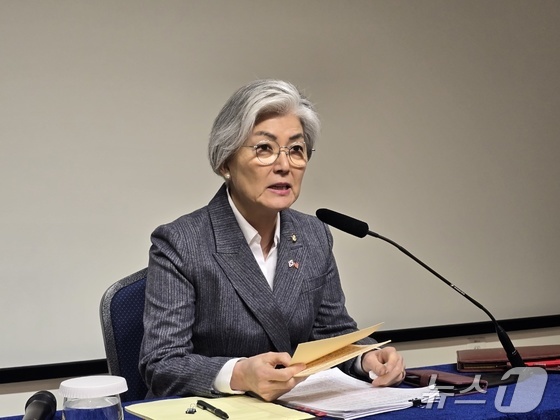
On Tuesday, South Korean Ambassador to the U.S. Kang Kyung-wha announced that following the U.S. Supreme Court’s decision to invalidate tariffs imposed under the International Emergency Economic Powers Act (IEEPA), the South Korean government plans to respond in a way that best serves its national interests.
During a press briefing with Korean correspondents at the Korean Cultural Center in Washington, D.C., Ambassador Kang noted that the ruling lacks clear guidance on refunding tariffs already paid, which leaves uncertainty surrounding the reimbursement process.
She elaborated that the embassy will closely monitor the Donald Trump administration’s follow-up actions and facilitate discussions with the U.S. in a cordial atmosphere. Regarding mutual tariff refunds not explicitly mentioned in the ruling, it will work closely with businesses and economic organizations to ensure the companies receive accurate information promptly.
In response to the Supreme Court’s ruling on mutual tariffs, the Trump administration implemented a 10% global tariff under Section 122 of the Trade Act, effective immediately. This tariff applies to nearly all items, excluding certain goods deemed essential for manufacturing, such as critical minerals, and specific products like automobiles and steel already subject to tariffs under Section 301 of the Trade Act. President Trump has announced plans to increase the tariff rate from 10% to 15%, and the White House is currently working on the necessary steps to implement this change.
Regarding the Joint Factsheet that reduced the 25% mutual tariff imposed on South Korea to 15% under IEEPA, Ambassador Kang stated that since President Trump mentioned a potential tariff increase on South Korea via social media on January 26, citing delays in the National Assembly’s investment legislation, the embassy has been in close communication with various levels of the U.S. administration to verify the facts and manage the situation to prevent further escalation.
Ambassador Kang continued that the Foreign Minister, Minister of Trade, and Chief Trade Negotiator have all visited the U.S. to clearly convey the government’s firm commitment to investment. They’re actively working to establish a bipartisan special committee to expedite the passage of the special investment law and have launched a strategic investment implementation committee to review potential U.S. investment projects even before the law takes effect.
She emphasized that it aims to support rapid progress in cooperation across the three agreed areas of the Joint Factsheet: nuclear enrichment and reprocessing, nuclear-powered submarines, and shipbuilding.
The recently announced U.S. Marine Action Plan (MAP) includes opportunities for partnerships with allies, which it will use as a reference to achieve mutually beneficial outcomes in shipbuilding cooperation, she added.
It was reported that U.S. Trade Representative Jamieson Greer met with Ambassador Kang on the same day the Supreme Court ruled that tariffs imposed under IEEPA were unlawful.
Regarding North Korea’s ongoing 9th Workers’ Party Congress, which began on February 19 she commented that Kim Jong Un reinforced the nation’s international status and showcased achievements in economy, defense, and diplomacy during his opening remarks. His reappointment as General Secretary appears to have further strengthened his position.
She added that messages directed at South Korea and the U.S. have not yet been released, and there is significant interest in what will be disclosed. It is closely monitoring developments related to potential U.S.-North Korea dialogue, considering all possibilities in light of President Trump’s upcoming visit to China in April.
Ambassador Kang stated that they’re observing the situation comprehensively, taking into account various factors such as the Russia-Ukraine war, U.S.-China relations, and North Korea-China relations.
She explained that the embassy is in constant communication with the White House’s National Security Council (NSC), the State Department, and other levels of the administration to share information on North Korea’s domestic and international trends and discuss policy directions.
She noted that the U.S. side has consistently stated that there will be no changes in its North Korea policy and that it will communicate closely to ensure nothing surprising occurs regarding South Korea. She added that Jeong Yeon-du, head of the Ministry of Foreign Affairs’ Strategic Information Division, is scheduled to visit the U.S. starting today for related discussions.
Meanwhile, the South Korean government believes there is a significant possibility that the Trump administration may impose tariffs on South Korea under Section 301 of the Trade Act as an alternative following the Supreme Court’s ruling on mutual tariffs.
Section 301 allows for retaliatory tariffs in response to unfair trade practices by the counterpart country and was utilized during the trade war with China in Trump’s first term. The U.S. is expected to decide by early March whether to initiate an investigation under Section 301.
The Trump administration intends to maintain tariffs as a Plan B following the Supreme Court’s decision by utilizing Section 232 of the Trade Expansion Act, Section 301 of the Trade Act, and Section 338 of the Tariff Act.
Additionally, regarding the House Judiciary Committee’s recent summons of Harold Rogers, the interim representative of South Korea’s Coupang, to investigate alleged discrimination against Coupang in the U.S., the South Korean government has reportedly maintained that a thorough investigation into personal data leaks is necessary for consumer protection and has communicated this position to the U.S. side.