

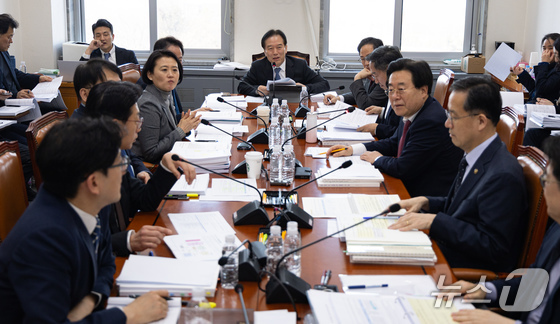
The South Korean National Assembly is set to process the Special Bill for Strategic Investment Management with the U.S. (Special Bill for U.S. Investment) this week, establishing a legal framework for a 350 billion USD investment package targeting the U.S. This development is expected to accelerate the formation of the Korea-U.S. Strategic Investment Corporation, dedicated to managing U.S. investments, and expedite the selection of the inaugural investment project.
The U.S. administration has reportedly responded favorably to updates on the legislative progress in South Korea. Industry Minister Kim Jeong-gwan, who returned from a U.S. trip on March 8 to discuss investments, stated that he was informed that if Korea passes the law and implements the negotiated terms, there likely won’t be any announcements regarding tariff increases.
According to National Assembly and government sources on Monday, the Special Committee for Processing the Special Bill for U.S. Investment plans to convene today to vote on the bill. If approved, it will undergo review by the Legislative and Judiciary Committee before potentially being put to a vote in the plenary session on March 12.
Following the bill’s passage, the U.S. Investment Corporation is expected to launch officially within the first half of the year, after about three months of preparatory work including drafting bylaws and structuring the organization. However, with the U.S. pressing for swift investment execution and wielding the threat of tariff hikes, the government aims to proactively review candidates for the ‘first project’ independently of the corporation’s establishment.
The path to legislating the Special Bill for U.S. Investment has been rocky. Initially proposed on November 26 last year following U.S.-Korea discussions on tariffs and investments, the bill was meant to support the 350 billion USD investment package domestically. However, it stalled in the National Assembly’s Finance Committee due to competing priorities.
The situation shifted on January 26 this year when U.S. President Donald Trump publicly criticized the pace of South Korea’s investment implementation, hinting at possible tariff reinstatement. This prompted both ruling and opposition parties to form a special committee to expedite the bill’s processing.
Yet, even after the special committee’s formation, progress remained slow. Conflicts over other issues, including judicial reform bills, disrupted meetings and prevented substantive deliberation on the U.S. investment bill.
Once bill review finally began, debates erupted over the structure of the new entity. Lawmakers grappled with whether to create a new corporation or leverage existing institutions like the Korea Investment Corporation (KIC), and how to implement National Assembly oversight.
The current compromise between parties includes establishing the Korea-U.S. Strategic Investment Corporation with built-in oversight mechanisms. These include a board of directors, an investment review committee, and multiple layers of checks in coordination with the Industry Ministry’s Business Management Committee.
Under this structure, U.S. investment projects will first be vetted by the Business Management Committee. This body will assess projects based on commercial viability, strategic importance, and legal risks before referring them to the investment review committee.
The investment review committee, chaired by the Deputy Prime Minister for Economic Affairs, will have final decision-making authority. It will reassess projects based on investment necessity, strategic alignment, and financial considerations, ultimately approving both investments and fund disbursements.
Following the committee’s decision, the Industry Minister will engage in final discussions with U.S. counterparts to cement project details.
Information disclosure will generally be open, with exceptions for national security and corporate confidentiality. Regular reports will be made to the relevant parliamentary committee, with provisions for pre-reporting on larger-scale projects.
As South Korea Navigates Legislative Hurdles, Japan Advances on Second U.S. Investment Project
While South Korea works through its legislative process, Japan, unburdened by such requirements, announced several U.S. investment projects last month. These include a gas-fired power plant in Ohio, an artificial diamond facility in Georgia, and oil and gas export port upgrades in Texas.
Ahead of the mid-March U.S.-Japan summit, Japan’s Economy Minister Ryosei Akazawa visited the U.S. to discuss investment projects, fueling speculation about additional announcements. Potential areas include collaborations in displays, nuclear power, and copper smelting.
The U.S. has reportedly highlighted the disparity in progress between Japan, which has finalized its first project, and South Korea, using this to pressure for faster action and threaten tariff increases.
To address these concerns, South Korea’s Industry Ministry is fast-tracking the review of potential first U.S. investment projects, separate from the corporation’s establishment. They’re evaluating project viability even before the special bill passes, aiming for quick implementation once the corporation is formed.
Leading candidates for the inaugural project include ventures in nuclear power, a liquid natural gas (LNG) terminal in Louisiana, shale gas production facilities, and chemical plants in Texas and Louisiana.
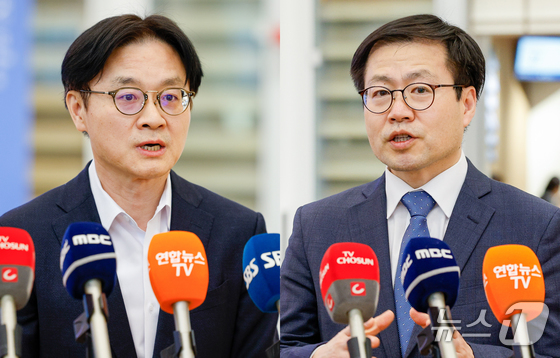
Industry Minister Kim, fresh from U.S. discussions, met with Commerce Secretary Howard Lutnick to brief him on the bill’s progress and reaffirm South Korea’s commitment to swift action. He reported a positive U.S. response.
Speaking to reporters at Incheon Airport, Kim stated that he was told that if Korea passes the law and implements the agreed terms as planned, there likely won’t be any announcements about tariff increases.
He added that he explained to Secretary Lutnick about our National Assembly’s expected passage of the law next week. The U.S. side greatly appreciated this and expressed their gratitude.