

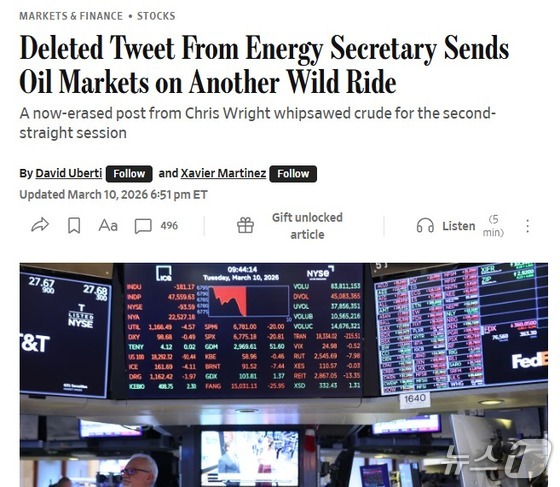
The Wall Street Journal (WSJ) on Tuesday took aim at the U.S. government for exacerbating uncertainty during an already volatile period, citing a careless tweet by the Energy Secretary that sent oil prices on a wild ride.
The incident unfolded as follows: Energy Secretary Chris Wright posted on X that the U.S. Navy was escorting vessels through the Strait of Hormuz.
This news triggered a sharp reaction in the markets. West Texas Intermediate (WTI) crude oil futures nosedived by nearly 20%, touching 73 USD per barrel, while U.S. stocks rallied.
The celebration was short-lived, however, as the White House swiftly debunked the claim.
White House Press Secretary Karoline Leavitt officially stated that U.S. warships had not been escorting any oil tankers.
Faced with this contradiction, the Energy Secretary promptly deleted his tweet.
In the aftermath, oil prices regained some ground, ending the day down 12% at 83.45 USD per barrel compared to the previous trading session.
U.S. stocks also reversed course, closing lower across the board, with only the Nasdaq managing a slight gain.
The WSJ calculated that during the roughly 10-minute window when Secretary Wright’s post was live, approximately 84 million USD evaporated from oil futures-linked exchange-traded funds (ETFs).
Robert Yager, a commodities analyst at Mizuho Securities, didn’t mince words, calling it an unforgivable mistake and sharply criticizing the U.S. government, the WSJ reported.