

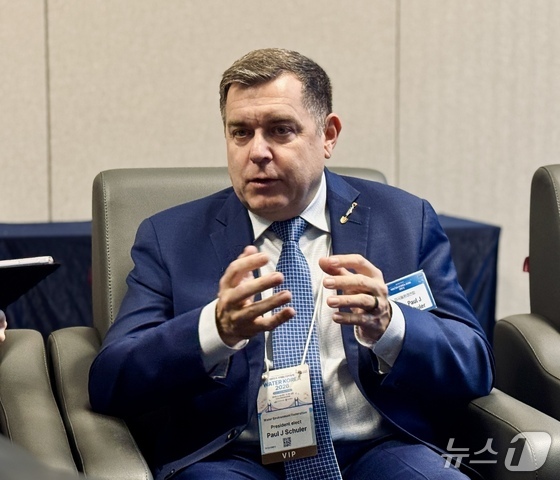
For Korean water-related companies to break into the U.S. market, establishing joint ventures with local firms or at least assembling products within the U.S. could be a game-changer, according to Paul Schuller, the incoming president of the Water Environment Federation (WEF). Schuller shared these insights on Wednesday at the Busan Exhibition and Convention Center (BEXCO) in Busan’s Haeundae district.
The WEF, the world’s largest nonprofit organization dedicated to water issues, boasts an impressive 30,000 members and 75 international member organizations.
Schuller brings to the table about 23 years of expertise in water treatment technology, having worked with industry giants like GE and Suez Water.
His recommendations offer a potential lifeline for Korean water companies facing a saturated domestic market. In Korea, where water supply coverage has reached 99.4% and sewage systems cover 94-95% of the population, there’s little room for new infrastructure projects.
With limited opportunities for new pipeline expansion, the industry is struggling to grow.
Take the Korea Water Resources Corporation, for example. As domestic projects for new dams and water supply systems dried up, the company pivoted to international markets. It’s now involved in water purification and supply operations in Vietnam and the Philippines, ramping up its presence in operation and maintenance (O&M) projects.
Private sector players have followed suit. Firms like GS Engineering & Construction and Doosan Enerbility have shifted their focus to seawater desalination, industrial water treatment, and overseas plant markets. Their successful bids for desalination projects in the Middle East are particularly noteworthy.
Schuller urged Korean companies to broaden their international scope, noting that the domestic market has become overly fixated on managing aging pipelines.
Against this backdrop, the recent Korea International Water Industry Expo (WATER KOREA) saw 216 companies showcasing cutting-edge water technologies. From water supply and sewage systems to seawater desalination and industrial water treatment, the expo highlighted innovations that could propel the industry beyond traditional pipeline maintenance. Smart water systems leveraging artificial intelligene (AI) and information and communications technology (ICT), along with energy-efficient treatment processes, emerged as potential game-changers.
The push for international expansion was evident at the expo. Yoo Myung-soo, executive vice president of the Korea Water and Wastewater Association, emphasized the importance of a export and purchasing consultation meeting that connected domestic firms with about 60 overseas buyers. He noted that this platform could open doors to new business opportunities, especially in regions with high water infrastructure demand like the Middle East and Southeast Asia.
Side events at WATER KOREA zeroed in on water management’s critical role in addressing the climate crisis. Kim Han-seung, first deputy minister of the Ministry of Climate, Energy, and Environment, pledged government support for domestic water companies. He promised to boost the development of cutting-edge water management technologies, including AI applications, to enhance their global competitiveness. Kim also committed to comprehensive support throughout the industry lifecycle, from startups to demonstration projects and exports.