Google’s development of TurboQuant sent South Korean memory stocks into a tailspin, triggering a domino effect that extended to U.S. memory stocks.
In New York trading on March 26 (local time), major industry players took significant hits. Micron Technology, the largest U.S. DRAM manufacturer, fell 6.97%. SanDisk, a leading NAND memory producer, plunged 11.02%. Western Digital, SanDisk’s parent company, dropped 7.70%, while Seagate declined 8.33%.
Micron closed the day at $355.46, down 6.97%.
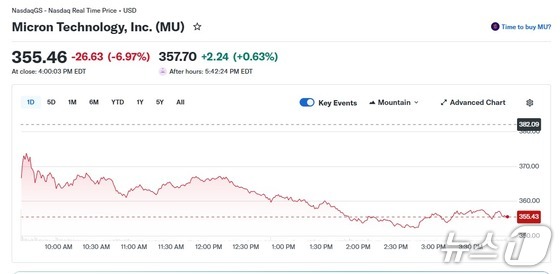
The selloff was triggered by Google’s research team unveiling a revolutionary compression technique that drastically reduces memory requirements for artificial intelligence (AI) applications. Known as TurboQuant, the technology reportedly cuts memory usage to one-sixth while boosting AI inference speeds by up to eightfold.
The news sent shockwaves through Asian markets. Samsung Electronics and SK Hynix fell 4.71% and 6.23% respectively on their local exchange.
Japan’s Kioxia, a major player in flash memory manufacturing, declined about 6% on the Tokyo Stock Exchange.
This ripple effect quickly spread to U.S. markets, weighing heavily on Micron.
SanDisk wasn’t spared either, with its shares plummeting 11.02% to close at $603.17.
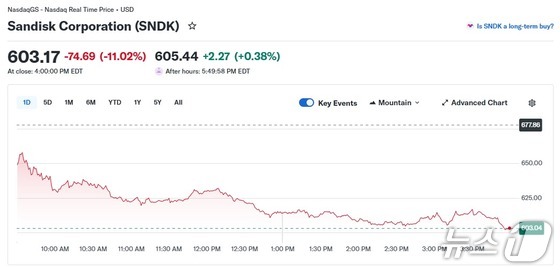
While SanDisk had already experienced a 3% dip the previous day, the widespread panic in Asian memory markets amplified its losses to a staggering 11%.
The market tremors, originating in Asia, quickly spilled over into Wall Street.
Losses continued with Western Digital, SanDisk’s parent company, fell 7.70%, while Seagate dropped 8.33%.
As memory stocks declined across the board, the semiconductor index also fell sharply, down 4.79%.