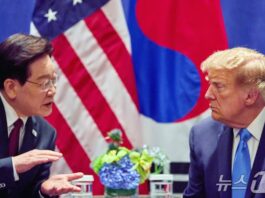
President Donald Trump’s declaration of “America’s Liberation Day” marked the one-year anniversary of the global tariff war he initiated. Initially, there were significant concerns that the Trump administration’s aggressive tariff policies would deal a severe blow to South Korea’s export-driven economy. However, the prevailing assessment now is that the worst-case scenarios were largely avoided.
Nevertheless, experts caution that the situation remains far from secure. Ongoing external uncertainties contributed to South Korea’s economic growth rate stagnating at 1.0% last year, with Trump’s policies playing a decisive role in this sluggish growth. As the U.S. midterm elections approach, there are warnings that the Trump administration could reintroduce stringent tariffs at any moment.
While major institutions project this year’s growth rate to hover around 2%, this figure largely reflects a base effect from last year’s tepid performance. With the added complication of the Middle East conflict, there’s a real possibility that the actual growth rate could remain stuck in the 1% range.
$350 Billion Deal Helps South Korea Avoid Worst-Case Scenario, but Growth Slows to 1%
On Sunday, relevant departments reported that South Korea’s exports surpassed $700 billion for the first time, reaching a record $709.7 billion. This represents a 3.8% increase from the previous year, driven largely by a surge in semiconductor demand, which skyrocketed 22.2% to an all-time high of $173.4 billion. The automotive sector also diversified its markets, achieving record exports of $72 billion to regions such as the EU and the CIS.
However, when focusing solely on exports to the U.S., the scars from tariffs are evident. Exports to the U.S. fell by 3.8% to $122.9 billion, particularly in key tariff-affected categories such as automobiles, machinery, and auto parts. This marks the first decline in U.S. exports since 2016. Notably, automotive exports to the U.S. plummeted by 13.5%. Analysts suggest that without the double-digit growth in semiconductors, the decline would have been far more severe.
The impact of tariffs is also reflected in macroeconomic indicators. South Korea’s economic growth rate sank to 1.0%. While some view this as a better outcome compared to initial fears of zero growth, tariffs undeniably played a critical role in dragging down the growth rate.
Kim Jong Sik, an emeritus professor at Yonsei University, said the impact of tariffs rising from zero was evident, but noted that a $350 billion investment agreement that lowered tariffs to 15%, similar to Japan, helped limit the overall damage.
Kim Sang Bong of Hansung University added that South Korea responded relatively effectively compared to other countries, negotiating and showing a willingness to invest when tariff issues arose.
With the midterm elections in November and the ongoing conflict in Iran, concerns about persistent uncertainties are mounting.
This year, major institutions like the Korea Development Institute (KDI) and the Bank of Korea project growth rates around 1.9%. However, this figure largely reflects the base effects from last year’s low growth. As K-shaped growth centered around semiconductors intensifies, the domestic and export sentiment remains challenging. Considering geopolitical risks such as the conflict in Iran, growth rates could remain stuck in the 1% range.
Experts express particular concern about the upcoming U.S. midterm elections in November. Currently, President Trump’s approval ratings are low, especially in battleground states, leading analysts to suggest that he might resort to tough foreign policy measures to rally his support base.
Professor Kim Sang Bong said that with the midterm elections approaching and approval ratings weak, the Supreme Court ruling against reciprocal tariffs could lead to extended legal efforts to impose tariffs through alternative mechanisms, potentially bringing trade issues back into focus during the election period.
Professor Kim Jong Sik added that continued protectionist policies from the United States are likely and that a return to previous trade practices would be difficult. However, he noted that current tariff levels are expected to remain relatively stable, which could help ease some uncertainty compared with last year, while cautioning that additional demands could still emerge.
The conflict in Iran adds another layer of complexity. The Organization for Economic Cooperation and Development (OECD) recently lowered its growth forecast for South Korea to 1.7%, a 0.4 percentage-point reduction from last December. South Korea, which relies heavily on energy imports, experienced one of the largest downward adjustments among G20 countries, second only to the UK.
Ju Won, head of research at Hyundai Economic Research Institute, said there remains a significant possibility that tariff measures could be reintroduced depending on the situation. He noted that while tensions in Iran are currently the dominant concern, the economic impact could grow depending on how U.S. “America First” policies evolve.