

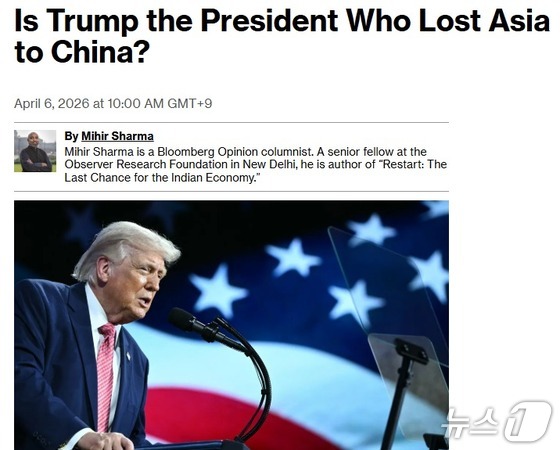
As the U.S.-Iran war enters its sixth week, Asian countries aligning with China are weathering the storm well, while those siding with the U.S. face significant challenges. Bloomberg reported on April 6 that President Trump risks being remembered as the U.S. leader who ceded Asia to China.
Nations like Pakistan and Nepal have successfully adopted Chinese solar technology and electric vehicles, shielding them from the severe impact of soaring oil prices caused by the U.S.-Iran conflict.
In contrast, South Korea and Japan are grappling with the surge in oil prices.
Pakistan, in particular, has shown remarkable resilience. The country had previously relied heavily on energy imports via the Strait of Hormuz, which led to economic turmoil during Russia’s invasion of Ukraine just a few years ago.
However, the situation is different this time due to the implementation of Chinese solar technology.
Since 2024, Pakistan has been generating approximately 17 gigawatts of solar power annually. A quarter of all households are equipped with Chinese solar panels.
Nepal has also embraced Chinese electric vehicles, achieving the world’s second-highest market share, trailing only Norway.
Notably, with support from China, Nepal has launched large-scale hydropower projects to power its electric vehicle infrastructure, allowing it to remain relatively insulated from the recent spike in oil prices caused by the U.S.-Iran war.
These developments suggest that developing countries in Asia are likely to continue aligning with China.
Moreover, countries in sub-Saharan African have recently stepped up imports of Chinese solar panels, indicating that both Asia and Africa are increasingly falling under China’s sphere of influence.
In contrast, countries such as South Korea, which believed that the open trade order based on U.S. hegemony would protect them, are now struggling.
If the U.S. withdraws from the Middle East without securing the Strait of Hormuz, countries around the world may increasingly turn to China to reduce their reliance on the U.S.
The choice seems clear: Should countries opt for Beijing’s predictable mercantilism or the capricious, self-centered, and chaotic nature of the U.S.?
If the U.S. withdraws from Iran without reopening the Strait of Hormuz, it will not just be a matter of losing face; it will likely result in a significant geopolitical setback, pushing Asian nations to align themselves with China.
Trump appears to want to be remembered as the president who restored America’s greatness. However, Bloomberg predicts he is more likely to be remembered as the president who lost Asia to China.