
Polymarket, a blockchain-based decentralized prediction market, is drawing attention for its forecasts on the possibility of a ceasefire between the U.S. and Iran. The platform’s accuracy was highlighted when the probability of a truce surged above 50% just before the official announcement, demonstrating its ability to effectively harness collective intelligence.
As major financial institutions on Wall Street increasingly invest in and collaborate with prediction markets, analysts suggest these platforms are emerging as a new frontier in data-driven decision-making.
As of 3:57 p.m. (Korean time) on Wednesday, Polymarket users have wagered a staggering 15.81 million USD on the question, When will President Donald Trump terminate military operations against Iran? This substantial sum underscores the high level of user engagement on the platform.
Notably, around 5:00 a.m. (Korean time) that day, the likelihood of an April ceasefire between the U.S. and Iran reached approximately 46%, marking a significant jump from the previous day’s 30% range.
In the hours leading up to the U.S. announcement of halted airstrikes and a ceasefire with Iran, the probability skyrocketed to 57%. This surge reflected growing optimism fueled by reports of positive developments in ceasefire negotiations and discussions about a temporary truce and phased reopening of the Strait of Hormuz.
On Tuesday, President Trump declared a two-week suspension of attacks against Iran, contingent on the immediate reopening of the Strait of Hormuz. Iranian Foreign Minister Abbas Araghchi reciprocated by agreeing to a Pakistan-proposed two-week ceasefire and pledging to cease defensive operations. Iran has since communicated ten proposals to the U.S. through Pakistani intermediaries.
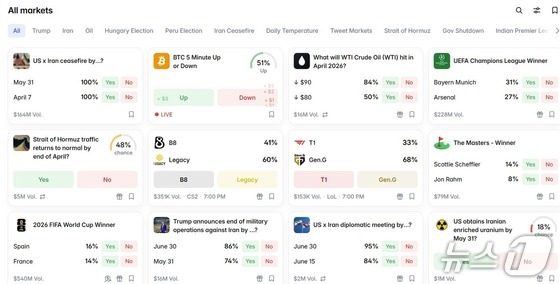
Polymarket, alongside Kalshi, stands as a leading decentralized prediction market platform. The system leverages blockchain technology to store all voting and transaction records on a distributed ledger, with smart contracts facilitating automatic settlements.
Users can place bets using stablecoins on a wide array of future events spanning politics, economics, and sports. The platform’s real-time probability adjustments reflect the evolving collective intelligence of its user base, making Polymarket a closely watched barometer of public sentiment.
The platform’s predictive power was notably demonstrated during the 2024 U.S. presidential election when it projected a 60% probability of a Trump victory, outpacing traditional polling estimates. Earlier last year, it also forecasted an 81% likelihood of former President Yoon Suk Yeol’s impeachment.
Recent reports indicate significant profits from war-related bets on the platform. Some users reportedly netted over 1 million USD by accurately predicting U.S. airstrikes against Iran in late February.
Polymarket’s scope extends beyond political and military events, offering predictions on diverse topics such as the West Texas Intermediate (WTI) crude oil prices, Seoul temperatures, and even the social media activity of Tesla Chief Executive Officer (CEO) Elon Musk.
Wall Street’s interest in Polymarket continues to grow, with Intercontinental Exchange, the parent company of the New York Stock Exchange (NYSE), investing 1.6 billion USD in the platform since October of last year.
In a strategic move, Polymarket has partnered with Dow Jones to provide prediction data to major media outlets, with plans to offer market expectation data during earnings seasons.
Both Polymarket and Kalshi are seeking investments to reach an estimated enterprise value of 20 billion USD. NYSE Chairman Lynn Martin has noted that prediction market results are increasingly being factored into investment decisions in traditional financial markets.
Despite its growing influence, the platform faces ongoing ethical and regulatory challenges. Critics raise concerns about betting on life-or-death scenarios like wars, and allegations of insider trading have surfaced.
Senator Chris Murphy (D-CT) has announced plans to introduce legislation banning certain prediction markets, citing concerns that government officials may exploit privileged military information for personal gain.
Legal challenges are mounting, with a Nevada court issuing a two-week suspension order against Polymarket’s operator, Blockratize, and a Massachusetts court demanding Kalshi cease its sports-related prediction market operations.
Internationally, Dutch regulators have classified Polymarket as an illegal gambling service and prohibited its operations, while Argentina has blocked access to the platform following insider trading allegations.