

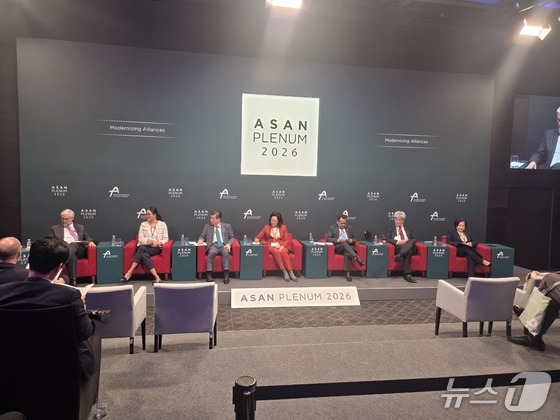
Modernizing alliances presents both security challenges and economic opportunities. Jin Choi, an energy and economic security analyst at the U.S. Department of State’s Bureau of Economic Analysis, emphasized the expansion of the alliance concept during Session 3 of the Asan Plenum 2026 held at the Grand Hyatt Seoul on April 8.
Choi noted that while past alliances had focused on military security, today’s competition revolves around semiconductor manufacturing, liquefied natural gas (LNG) infrastructure, and artificial intelligence (AI) standards. He stressed that cooperation in energy and critical mineral supply chains is essential, emphasizing the need for closer coordination among like-minded nations to counter China-centric supply chains.
These changes are already evident in businesses and industrial sectors. James Kim, president of the American Chamber of Commerce in Korea, said the U.S.-Korea economic relationship has been built on trust, adding that business ultimately follows that trust. He noted that technology, supply chains, and industrial policy have become central pillars of the alliance.
Kim also observed that while globalization has driven growth, it has also created imbalances. He said the U.S. reshoring movement and efforts to strengthen economic security are fundamentally changing how alliances operate. While acknowledging Korea’s advantageous position, Kim pointed out that structural constraints such as regulations and labor market issues persist. He emphasized that regulatory reform will be key for Korea to position itself as a regional business hub.
The shift in alliance focus towards industry is particularly evident in the semiconductor sector. Former Minister of SMEs and Startups Young Sun Park said that semiconductors are no longer merely components of electronic devices but a foundation of economic security. She described them as core infrastructure supporting AI, finance, and defense capabilities.
Park noted that while the semiconductor industry appears global in scope, core technologies remain concentrated in Northeast Asia, a region also marked by intensifying geopolitical competition. She asserted that Korea is a key pillar of the global supply chain and emphasized that the country must move beyond being merely a production hub to take on a greater role in supply chain design.
Park concluded that a new form of alliance—one centered on technology and supply chains—is now needed, going beyond traditional military alliances. She called for the establishment of an economic security alliance encompassing joint investment, technology protection, and coordinated responses to supply chain disruptions.