

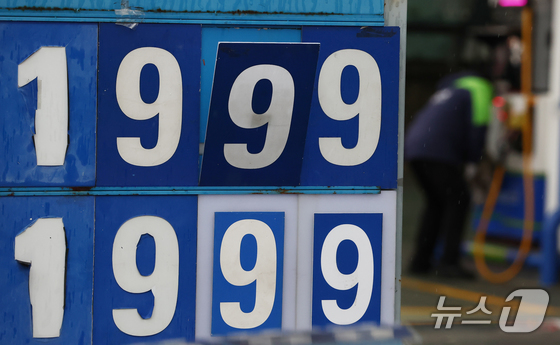
On Tuesday, the United States and Iran effectively agreed to a two-week ceasefire, signaling a potential reopening of the Strait of Hormuz. However, experts say domestic fuel prices in South Korea are unlikely to decline in the near term. Some analysts note that while price increases may not be as steep as during the conflict, the upward trend could continue for some time.
In South Korea, fuel prices are influenced by global oil markets, which saw a significant spike following the Strait of Hormuz blockade. Industry insiders believe that international product prices would need to fall considerably for consumers to experience noticeable relief at the pump. Estimates for a return to pre-conflict pricing levels range from as little as three months to as late as year-end.
Immediate Fuel Price Relief Unlikely as Government Prepares Third Round of Controls
On Wednesday, the average gasoline price in major U.S. cities hit a three-year high, continuing a 13-day upward trend following the second price regulation. According to the Energy Information Administration (EIA), the national average gasoline price in South Korea was about $5.60 per gallon, up roughly $0.02 from the previous day. In urban areas, prices were even higher, with some cities reporting averages above $5.70 per gallon.
Despite the U.S.-Iran ceasefire agreement and the anticipated reopening of the Strait of Hormuz, which is expected to cause a plunge in global oil prices, domestic fuel prices in the U.S. are not expected to drop immediately.
An energy industry analyst said it could take one to three months for oil production in the Middle East to normalize, adding that even if global oil prices fall, declines in refined product prices are likely to be more limited in the short term.
There is a strong possibility that fuel prices could rise further. The government plans to implement a third round of price regulations starting April 10, reflecting the increase in global refined fuel prices over the past two weeks. Previous measures set price caps for different fuel types, with the first round capping gasoline at about $4.90 per gallon, diesel at $4.85 per gallon, and kerosene at $3.75 per gallon. The second round raised those caps to roughly $5.50 per gallon for gasoline, $5.45 per gallon for diesel, and $4.35 per gallon for indoor kerosene. With recent increases in global fuel prices, the third round of caps is expected to be set even higher.
An industry insider commented that, given that the third round of price caps will be calculated based on the average of two weeks of oil product prices, it’s inevitable that they will increase.
Looking ahead, there are expectations for a long-term decline in prices, with a potential return to pre-conflict levels occurring as soon as three months from now.
If the Strait of Hormuz remains open, fuel prices are likely to trend downward in the long run. A drop in global oil prices will also lead to lower refined product prices. However, analysts expect the decline in refined product prices to be more gradual than that of crude oil prices, so they won’t fall as sharply.
Another industry source said that while current refined product prices remain elevated, they are expected to decline if global oil prices fall following the reopening of the strait. A separate analyst added that refined product prices are likely to decline more gradually than crude oil prices but should ease from current levels.
Nevertheless, predicting when domestic fuel prices will fall remains challenging. One industry representative said refined product prices are hard to forecast due to multiple variables, including speculative demand. Another source noted that, given current price levels, a significant decline would be needed for consumers to feel meaningful relief.
Restoring fuel prices in South Korea to pre-conflict levels is expected to take time. The refining industry estimates that recovery could occur as early as three months from now or as late as the end of the year.
A refining company representative said that even if the Strait of Hormuz reopens, transportation disruptions may not be resolved immediately, and it could take one to three months for oil production in the Middle East to normalize. The representative added that recovery could begin in as little as three months but may take until the end of the year under more conservative assumptions. Another source noted that damage to oil shipment infrastructure during the conflict could further delay recovery.