

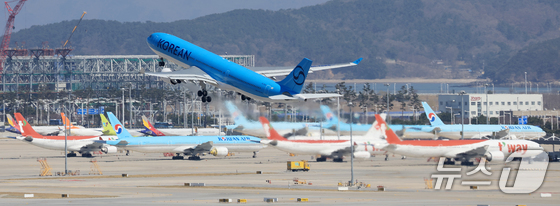
International fuel surcharges are set to double in May, raising red flags for airlines as travel demand slows and performance suffers.
Passengers flying to the U.S. from Seoul will face an additional cost of around 113,000 KRW (about 76 USD), while those headed to Europe will need to shell out about 45,000 KRW (about 30 USD) more.
Industry experts predict long-haul travel will likely take the first hit. If high oil prices and unfavorable exchange rates persist, even short-distance leisure trips could feel the pinch.
Some airlines are already tightening their belts by reducing flights and implementing unpaid leave, but analysts warn that boosting performance won’t be a walk in the park.
May Fuel Surcharge Jumps 2.1-Fold… First-Ever Level 33
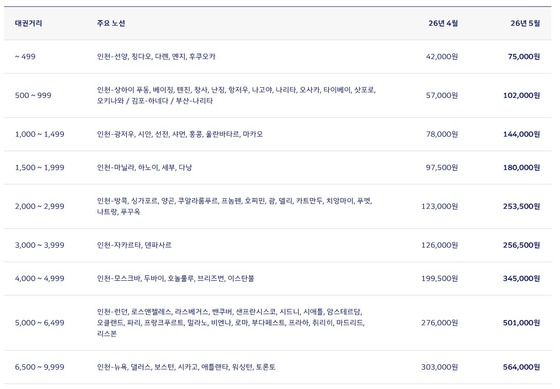
According to airline industry sources on Thursday, Korean Air plans to hike its international fuel surcharge for tickets issued next month by up to 2.1 times. This means Korean Air’s surcharge for international flights will jump from about 42,000-303,000 KRW (about 28-205 USD) to 75,000-564,000 KRW (about 51-381 USD) for one-way tickets.
Asiana Airlines isn’t far behind, with plans to boost its international fuel surcharge by up to 1.9 times for next month’s tickets, pushing the fee from roughly 43,900-251,900 KRW (about 30-170 USD) to 85,400-476,200 KRW (about 58-322 USD) for one-way trips.
The average price of Singapore jet fuel (MOPS) from March 16 to April 15, which sets the benchmark for May’s international fuel surcharge, hit 511.21 cents per gallon (214.71 USD per barrel), triggering the highest level – 33 – on the surcharge scale (over 470 cents per gallon).
This marks the first time fuel surcharges have reached level 33. The previous peak was level 22, recorded during the height of the Russia-Ukraine conflict in August 2022.
Not Just Long-Haul—Short-Haul Leisure Demand Also Slows… Downside Pressure on Earnings Seen Rising
The industry is bracing for a sharp reaction in long-distance travel demand, with concerns that the downturn could spill over into short-distance leisure trips.
An airline industry insider noted that when you factor in the fuel surcharge on top of the base fare, ticket prices could double within a month. It’s expecting a significant drop in demand, and airlines are likely to feel the squeeze on their bottom line.
As ticket prices soar, consumers will feel the sticker shock when booking. This could lead to lower passenger loads and airlines struggling to maintain their pricing power. If summer peak season demand for long-distance travel takes a hit, it could deal an even bigger blow to airlines’ financial performance.
Worried about declining profits, some airlines have already started belt-tightening measures like unpaid leave for cabin crew and route reductions. However, these tactics may prove insufficient if high oil prices become the new normal.
Even Korean Air, which posted record-breaking revenue in the first quarter, is on high alert. The airline plans to maintain its emergency management system as passenger demand may start to crumble in the second quarter when the fuel surcharge hikes kick in.
A Korean Air spokesperson stated that they’re implementing company-wide cost-cutting measures. It aims to strengthen our financial structure and use this challenging period as an opportunity to build a stable foundation for future growth.
Analysts predict the pressure on airline performance will only intensify. Yang Seung-yoon, an analyst at Eugene Investment & Securities, explained that even after the Iran-U.S. ceasefire and the resumption of navigation in the Strait of Hormuz, it’ll take several months for jet fuel prices to stabilize. It expects the impact of rising costs to really hit home after the second quarter, putting even more downward pressure on passenger demand from April onwards.