

The yield on the benchmark 10-year U.S. Treasury note, widely viewed as a barometer for the global economy, has climbed above the psychologically important 4.5% threshold. Analysts warn that if Treasury yields continue rising, foreign capital outflows and slowing growth in the semiconductor industry could trigger a correction in South Korea’s stock market, which recently surged to record highs.
According to the financial investment industry on May 18, the yield on the 10-year U.S. Treasury rose 0.136 percentage points to close at 4.595% on May 16 local time. The 30-year Treasury yield also climbed 0.115 percentage points to 5.128%, marking its highest level since July 2007, just before the global financial crisis.
Recent oil price gains driven by escalating conflict in the Middle East have intensified concerns that higher energy costs will fuel inflation. Expectations that central banks may respond with additional rate hikes to contain inflation have also pushed bond yields higher. In addition, concerns over increased U.S. fiscal spending and a potential rise in Treasury issuance tied to the conflict have increased the perceived risk of holding long-term government debt, further driving up yields.
In the securities industry, the 4.5% level on the 10-year Treasury yield is often regarded as a key “pain point” for financial markets. Historically, when yields move beyond that threshold, investors tend to shift funds from riskier assets such as equities into bonds, increasing the likelihood of stock market corrections.
Kim Seok-hwan, an analyst at Mirae Asset Securities, said markets typically view the 4.5% level on the 10-year Treasury as a “pain point,” noting that stock market pullbacks have often followed when yields exceeded that level. He added that even U.S. President Donald Trump had informally shown a tendency to “step back” when yields approached or surpassed the threshold, referring to the so-called “TACO” pattern.
In fact, the most recent peak for the 10-year Treasury yield was 4.792% on Jan. 14 last year. After the Nasdaq index closed at 19,044.39 that day, it continued to decline, falling to 15,267.91 by April 8 — a drop of 19.83% over roughly three months. During the same period, the S&P 500 index fell 14.72%, from 5,842.91 to 4,982.77.
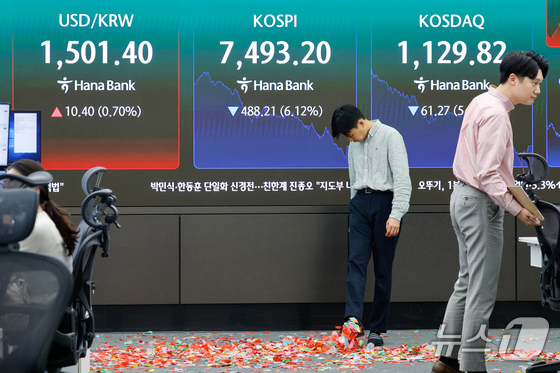
Markets are increasingly concerned that U.S. Treasury yields could rise even further. Analysts say that if the closure of the Strait of Hormuz drags on, prolonged oil price increases could intensify inflationary pressures and push yields higher still. Concerns over a prolonged Middle East conflict and rising oil prices also grew after the recent U.S.-China summit ended without visible progress.
Brokerages warn that South Korea’s stock market could face significant pressure in that scenario. As higher Treasury yields encourage investors to reduce exposure to risk assets, foreign investors may cut their holdings of South Korean equities, weighing on the KOSPI. A rising dollar-won exchange rate and the KOSPI’s rapid gains over a short period could also continue to encourage profit-taking by foreign investors. In fact, foreign investors were net sellers on the KOSPI for seven consecutive trading sessions from May 7 to May 15, offloading approximately $21.4 billion worth of shares.
Analysts also warn that if elevated Treasury yields persist, global Big Tech companies facing higher capital costs could slow the pace of artificial intelligence server capital expenditures, or CAPEX. That could weaken growth prospects for downstream semiconductor companies such as Samsung Electronics and SK hynix, creating additional downside risks for the KOSPI.
Industry experts say investors should closely monitor how long the Middle East conflict and rising oil prices continue when shaping investment strategies. Whether long-term U.S. Treasury yields maintain their upward trajectory will also be a key factor in determining whether to reduce equity exposure. In addition, any pullback in Big Tech CAPEX amid rising interest-rate pressure could determine whether the AI-driven market rally can continue.
Seo Sang-young, an analyst at Mirae Asset Securities, said rising Treasury yields are not always negative in themselves. However, he noted that the current rise is being driven less by confidence in economic improvement and more by geopolitical risks, inflation concerns, and bond market supply-demand pressures, which are heightening market anxiety.